
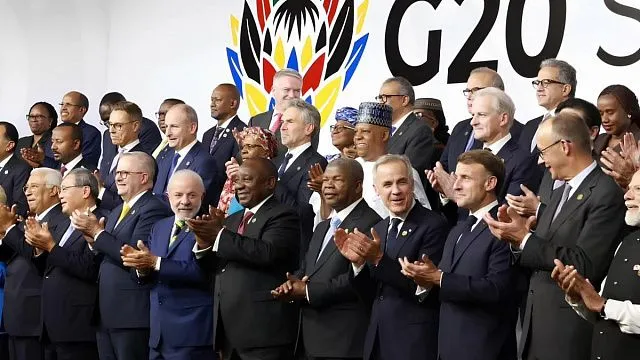

Leaders of the G20 member states concluded the 2025 Johannesburg Summit by agreeing on a set of measures aimed at strengthening global resilience, advancing a fair and just future for all, and placing the priorities of the Global South at the centre of international economic cooperation. This is reported by the official website of the South African Government.
South African President Cyril Ramaphosa underscored that the progress achieved this year was built on the foundations laid by Indonesia, India, and Brazil, whose consecutive presidencies over the past three years shaped the Group’s developmental agenda.
“South Africa has used this Presidency to place the priorities of Africa and the Global South firmly at the heart of the G20 agenda,” he said, adding that the outcomes were possible because “building on the developmental agenda of previous Presidencies in Indonesia, India and Brazil, we have prioritised the issues that matter most to developing economies.”

He emphasised that the Leaders’ Declaration is “more than words”, describing it instead as a concrete collective commitment to improving lives across the world and proof that the G20 remains a platform capable of delivering joint action on issues of shared concern.
The summit’s final session, “Session Three: A Fair and a Just Future for All”, outlined coordinated steps on critical minerals, decent work, and artificial intelligence, while formalising the recommendations prepared under South Africa’s Presidency.
Brazil stressed that critical minerals must serve as engines of technological development and sovereign industrial growth, arguing that resource-rich nations must not be confined to the role of raw-material suppliers, as reported by the official website of the Brazilian Government.
President Lula da Silva said that the management of these resources, alongside AI and the future of work, will define global prosperity and called for an international framework that safeguards workers’ rights in a rapidly changing technological landscape.

India supported this direction, highlighting the need for human-centric AI, equitable access to high-performance computing, and population-scale digital skills. Prime Minister Narendra Modi reiterated India’s call for a global AI compact centred on transparency and safety-by-design, confirming that India will host the AI Impact Summit in early 2026. He linked technological development to sustainable growth, recalling India’s commitment to trusted trade, fair finance and inclusive prosperity, reports the official website of the Ministry of External Affairs of India.
China emphasised that the world is facing overlapping challenges in climate, energy, and food security and urged the G20 to deepen international cooperation across these areas. Premier Li Qiang called for accelerated implementation of biodiversity and climate agreements, stronger green-energy partnerships, and reinforced support for food-insecure countries.

According to Xinhua News Agency, a partner of TV BRICS, he reaffirmed China’s readiness to advance responsible AI governance, enhance mutually beneficial cooperation in critical minerals and expand development assistance to the Global South, particularly in Africa.
Vice President Gibran Rakabuming Raka stated that Indonesia would focus its intervention on AI governance and critical mineral security – areas Jakarta views as essential for global technological progress and for ensuring equitable economic transformation, reports
ANTARA.
South African Deputy Government Spokesman William Baloyi told TV BRICS that Pretoria viewed its role as representing not only the host nation but the entire continent and the wider developing world. He stressed that South Africa had deliberately placed sustainability, critical minerals, and equitable development at the centre of the discussions.
“We are looking at making sure that the developed, underdeveloped and economy-struggling countries are also given a space for improvement to improve the lives of the people,” he stated.
Collectively, the G20 agreed to expand support for low- and middle-income countries; scale up climate finance and strengthen multilateral development banks; enhance responsible and transparent cooperation on critical minerals; promote decent work amid rapid technological change; and advance international standards for trustworthy AI. The final declaration reaffirmed shared commitments to energy security, universal access, sustainable development, and the 2030 Agenda.
Photo:
official website of South Africa’s G20 Presidency /
CGTN / VCG /
Xinhua / Huang Jingwen /
Metropoles / Ricardo Stuckert / PR
Самые
актуальные новости стран БРИКС https://tvbrics.com