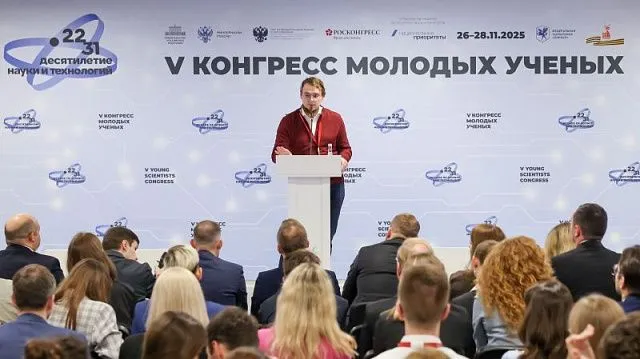

The V Young Scientists Congress, held on the federal territory of Sirius, showcased the results of five years of work, becoming the largest in its history. The TV BRICS International Media Network served as the event’s international information partner.
Over five years, the number of participants has tripled, and the number of countries has quadrupled. In 2025, 16,000 applications were submitted. The congress events brought together 8,000 people from 89 Russian regions and 100 foreign states, including representatives of 480 Russian and 44 foreign universities. A record level of international engagement reflects the strong interest of foreign guests in the inventions and discoveries of Russian scientists.
As part of the congress, 47 agreements were signed, bringing together representatives of business, research institutions, and public organisations. In 2025, the event was supported by more than 20 leading Russian companies actively developing scientific and technological fields – the number of business partners increased by 25 per cent.
At the end of the congress, its participants met with the President of Russia, Vladimir Putin, who emphasised that the goals of the event had been fully achieved.
“The goal was and remains to create a platform for open communication and exchange of views, ideas, and for establishing new contacts between people who want to pursue science. Because science, like art and sport, must be outside politics; it must unite people. From the very beginning, we sought to ensure a free exchange of views and the establishment of good relations primarily among young researchers,” the President stressed.
The key event of the congress was the plenary session on the theme “Energy of Science: From Knowledge Potential to Creating the Future”. It was moderated by Deputy Prime Minister of Russia Dmitry Chernyshenko, who stated that the foundation of the country’s sustainable development, as in the 20th century, continues to be a strong sovereign scientific and technological base, and that the national projects launched in 2025 have become the main tools for achieving technological leadership. From the new year, two more will be launched – “Space” and “Bioeconomy”.
The congress’s business programme included more than 550 events. They were held in the formats of discussions, lectures, masterclasses, film screenings, intellectual games, and presentations. More than a thousand people took part as moderators and speakers.
The business programme included the BRICS Social Sciences and Humanities Research Forum, which brought together young scientists from the BRICS countries and aimed at developing joint scientific projects, educational initiatives, and humanitarian exchanges.
The congress became the only event in Russia to simultaneously gather a record number of participants with academic degrees – more than 30 per cent of delegates. The average age of participants was 32.
Breakthrough domestic developments in various fields, from energy to medicine, were presented at the congress exhibition, whose area increased by 28 per cent compared with last year, reaching 8,900 sq. m., and the number of stands grew from 50 to 66.
The congress’s Science Lounge became one of the central spaces, demonstrating how the developments of Russian researchers are already improving lives today. More than 50 interactive exhibits were presented in this area.
The exhibition showcased for the first time: a method for the targeted destruction of tumours using focused ultrasound; a prototype of a microprocessor-controlled foot prosthesis; a portable sensor on an ultra-thin lens; a device for safe thyroid and pituitary gland surgeries; a next-generation digital capillaroscope – and this is only a tenth of the cutting-edge developments by young scientists.
For the first time, sector-specific clusters were organised at the congress exhibition – the Ministry of Transport of Russia and the Ministry of Construction of Russia presented their technological achievements.
This year, the congress expanded language services for foreign participants. The working languages of the event were Russian, English, Arabic, Chinese, Spanish, Portuguese, and Farsi. Interpretation into foreign languages was provided, including through the use of artificial intelligence technologies.
In addition, as part of the V Young Scientists Congress, an awards ceremony for the Union State Prize for Young Scientists was held for the first time, recognising research achievements in the natural, technical, and humanitarian sciences.
Photo: Sergey Kulakov, Roscongress Foundation
Самые
актуальные новости стран БРИКС https://tvbrics.com