
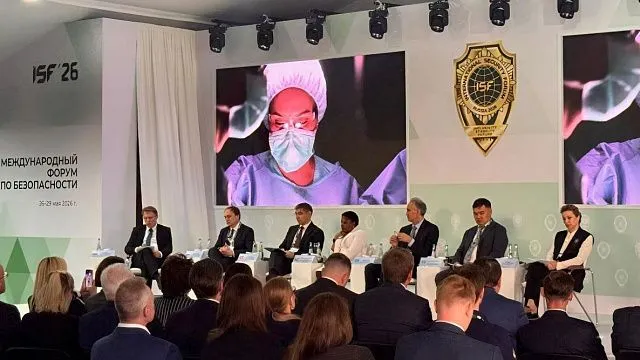

The International Security Forum, held under the auspices of the Security Council of Russia, has opened in the Moscow Region. TV BRICS is serving as the international media partner of the event.
More than 140 foreign delegations from over 120 countries are taking part in the forum, including nations from Africa, all member states of the Shanghai Cooperation Organisation (SCO), BRICS, the Association of Southeast Asian Nations (ASEAN), as well as most countries of the Middle East and Latin America. Among the participants are secretaries of security councils, heads of intelligence agencies, representatives of international organisations, and experts.
On the first day of the forum, a round table entitled “The Power of Cooperation for the Health of Nations”, organised by the Russian Ministry of Health, took place. Russian Minister of Health Mikhail Murashko delivered a keynote address.
#1095676#
The Minister also outlined the key priorities for the development of Russian healthcare through to 2030, including strengthening primary healthcare, preventing non-communicable diseases, advancing digital transformation, and implementing personnel policies that have increased the number of medical professionals.
Murashko also noted that Russia possesses its own reserve of vaccine technologies and is capable of developing new vaccines, including those targeting various strains, among them Ebola. According to the minister, epidemics, biological risks, non-communicable diseases, workforce shortages, and cyber threats are linked not only to the healthcare system but also to the country’s national security.

Photo: TV BRICS
In a comment to the TV BRICS International Media Network, the Official Representative of the Russian Foreign Ministry, Maria Zakharova, highlighted the importance of coordination and the development of common BRICS positions on creating a secure information space in the context of ongoing global digitalisation.
#1095674#
Practical experience of international coordination in healthcare was presented by South African Minister in the Presidency Khumbudzo Phophi Silence Ntshavheni. She stressed that epidemic response, cooperation, and coordination have become an integral part of international security in the post-pandemic era. During the COVID-19 pandemic, South Africa served as the African Union lead state for coordinating the response to the outbreak.
#1095675#
The importance of international cooperation was also emphasised by the World Health Organisation (WHO) Representative in Russia, Batyr Berdyklychev. He recalled that WHO does not possess supranational powers: each country independently determines its national healthcare policy. The organisation’s role is to bring together international experience, facilitate information exchange, coordinate responses, and develop standards and recommendations. All decisions are taken by the member states.
#1095677#
The forum will continue until 29 May.