
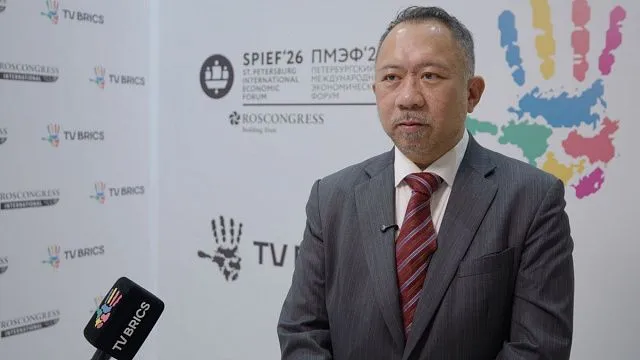

Eduardo Pedrosa, Executive Director of the Asia-Pacific Economic Cooperation (APEC) Secretariat, has said that digital cooperation and artificial intelligence are becoming key drivers of economic integration and business development across regions.
He made the statement in an exclusive interview at the TV BRICS studio in the Roscongress International Cooperation Area at the St. Petersburg International Economic Forum (SPIEF).
According to Pedrosa, the global economy is undergoing rapid technological transformation, largely driven by the private sector, which requires more effective coordination of principles and approaches across international organisations.
“What we are seeing today is an enormous wave of technological change. Everything is moving very quickly, mostly driven by the private sector,” he said.
He noted that APEC follows a principle-based and non-prescriptive approach, allowing member economies to implement agreed frameworks in line with their own national circumstances. This flexibility, he said, enables different regions to adapt digital economy policies more effectively.
Pedrosa highlighted that various regional initiatives – including digital economy agreements and e-commerce frameworks – demonstrate how digital integration is evolving through multiple complementary models across APEC, ASEAN, and other groupings.
The APEC Secretariat Executive Director stressed that such diversity of approaches creates opportunities for mutual learning, particularly in areas such as regulation, implementation and innovation policy.
Turning to small and medium-sized enterprises (SMEs), Pedrosa said that digital platforms and artificial intelligence are significantly reducing barriers to market entry and enabling businesses to expand internationally.
“When we integrate artificial intelligence into these systems, businesses can better understand consumer preferences. This allows products and services to be targeted more precisely and helps companies identify markets they may never have considered before. That is how AI and digital technologies can help SMEs expand globally while still operating within local markets,” he emphasised.
Pedrosa added that forums such as the St. Petersburg International Economic Forum, along with APEC and ASEAN business dialogue mechanisms, play an important role in facilitating discussions between governments and the private sector.
“I am still learning more about this forum, but what I already see is a strong sense of enthusiasm among businesses regarding the next phase of economic development. There is also a great deal of networking taking place. This creates opportunities for people to learn from one another and to discuss the practices they are introducing into their businesses, especially as business models continue to evolve,” Eduardo Pedrosa claimed.
He also pointed to ongoing technological shifts, including the platform economy and emerging fields such as quantum technologies, noting that continuous dialogue is essential to shaping effective international cooperation in a rapidly evolving digital landscape.