
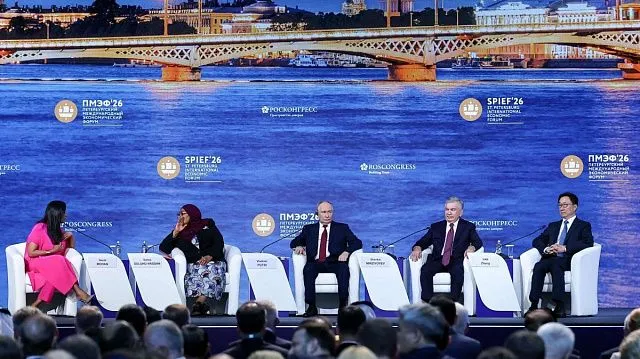

Since the establishment of BRICS, the member states have significantly increased their high-tech exports, which now account for more than one-third of global supplies, reflecting a shift in technological leadership worldwide. This was stated by Russian President Vladimir Putin at the plenary session of the 29th St. Petersburg International Economic Forum (SPIEF).
The Russian leader also drew the attention of participants at the plenary session, which this year included President of Uzbekistan Shavkat Mirziyoyev, President of Tanzania Samia Suluhu Hassan, and Vice President of the People’s Republic of China (PRC) Han Zheng, to the fact that over the past five years BRICS countries have generated nearly half of the annual growth in global gross domestic product (GDP).
“At present, BRICS accounts for approximately 40 per cent of global GDP measured by purchasing power parity. Business is naturally more interested in places where development is more dynamic and where there are prospects for increasing production and sales. Therefore, the focus of global trade, and with it the financial system, will also shift. In fact, it is already shifting. […] During the existence of BRICS, its share of global merchandise trade has more than doubled. Our member states accounted for almost a quarter of global exports. And this figure continues to grow steadily. So does intra-BRICS trade turnover, which has already exceeded US$1 trillion. […] BRICS countries have significantly increased high-tech exports. Our strategic partner China holds the largest number of patents in the field of artificial intelligence, where Russia also has very strong prospects. […] Another key partner of ours, India, is one of the leading players in the IT industry. It accounts for a substantial share of the global software market. Russia ranks highly in the pace of implementation of digital platforms, online marketplaces, financial solutions, and services in urban management, healthcare and education. These improve people’s quality of life both in Russia and in dozens of countries around the world. We are also leaders in such a complex field as nuclear energy. We possess considerable engineering and technological expertise in managing water and energy balances, which is becoming increasingly important in Asia, Africa and indeed throughout the world,” Putin noted.

Photo: Roscongress Foundation Photo Bank / Kirill Kazachkov
The Russian President stressed that the changes taking place globally are creating enormous opportunities, as the structure of growth is shifting in favour of the development centres of the Global South. These countries are experiencing population growth, the emergence of a middle class, the expansion of domestic markets and the development of their own scientific centres.
“The world becomes fairer when economic growth embraces billions of people who were previously on the periphery of the global economy. It is very important that the new centres of growth want to determine their own development trajectories. If we look at global GDP growth over the past five years, nearly half of its annual increase – 49 per cent – was generated by BRICS countries,” Putin added.
The day before, on the sidelines of SPIEF, Putin and Mirziyoyev launched the construction of a nuclear power plant (NPP) in Uzbekistan. The republic obtained the status of a BRICS partner state in 2025.
“For us, this is a project for long-term development, the creation of a new engineering school and the adoption of advanced technologies, as well as an intention to cooperate in other areas of the peaceful use of nuclear energy, including medicine, agriculture, industry, and science,” Mirziyoyev said during the session.
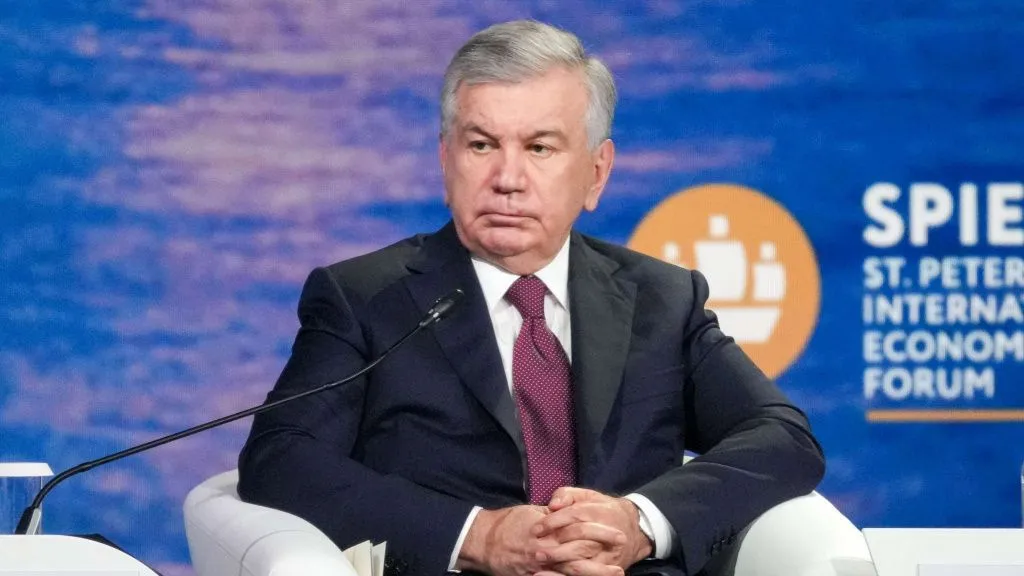
Photo: Roscongress Foundation / Aleksander Zholobov
The Uzbek leader also noted that the current portfolio of joint projects with Russia exceeds US$50 billion. Cooperation covers all key sectors, including energy, chemicals, petrochemicals, mechanical engineering, agriculture, logistics, textiles, food production, and many other industries. According to Mirziyoyev, Uzbekistan hosts 32 branches of foreign universities, 15 of which are Russian.
“This is the largest network of Russian universities abroad. […] Russia is more than just a regional neighbour for Uzbekistan. It is our time-tested strategic partner and ally. Today, our relations have entered a new era. Cooperation has become multi-level and multifaceted. We have moved from simple trade in goods to complex industrial chains, technological alliances, joint design projects and the localisation of production. According to our statistics, bilateral trade has more than tripled over the past ten years,” said the President of Uzbekistan.
President of Tanzania Samia Suluhu Hassan also spoke at the St. Petersburg Economic Forum about openness to cooperation, highlighting the enormous potential of African countries.
“By 2050, one in every four people on this planet will be African. Africa will remain the only continent capable of supplying labour to the global economy. Nine of the world’s twenty fastest-growing economies will be located on the African continent. Meanwhile, Africa’s middle class will exceed one billion people. At the same time, the African Continental Free Trade Area will be operating in full, turning us into the world’s largest single market by population. This is not a forecast; it is a straightforward arithmetic calculation. […] Africa has already developed its own model of development. It is clearly set out in the African Union’s Agenda 2063,” the Tanzanian President said.

Photo: Roscongress Foundation Photo Bank / Kirill Kazachkov
She also highlighted her country’s economic achievements, noting that in 2025 Tanzania attracted US$12 billion in foreign direct investment. In particular, a one-stop service for all investors willing to invest in the country’s economy was established that same year. New companies can now be registered online within 24 hours. As a result, Tanzania has become one of the fastest-growing investment destinations in Africa.
Vice President of the PRC Han Zheng emphasised the importance of digitalisation and global governance. According to him, China associates the concept of global governance with five principles: commitment to sovereign equality, adherence to international law, implementation of genuine multilateralism, a non-centred approach, and a results-orientated focus.
“The implementation of the Global Governance Initiative requires the joint efforts of the international community. As major world powers and permanent members of the UN Security Council, China and Russia bear an important mission in transforming the global governance system. Following the recent meeting in Beijing between President Xi Jinping and President Vladimir Putin, China and Russia issued a joint declaration on the development of a multipolar world and a new type of international relations. This document demonstrates the firm determination and responsibility of China and Russia, as leading powers, to jointly promote a fairer and more rational system of global governance,” Han Zheng said.

Photo: Roscongress Foundation Photo Bank / Kirill Kazachkov
Participants in the forum’s plenary session discussed the state of the global economy, the formation of a multipolar system and the search for a balanced economic strategy amid the transformation of global geo-economic conditions.
The plenary session brought together heads of state and government, ministers, chief executives of major companies and representatives of international delegations. More than 130 countries and territories were represented at the 29th St. Petersburg International Economic Forum, which is being held from 3 to 6 June. The main theme of the forum in 2026 is “Pragmatic Dialogue – the Path to a Stable Future”.
The TV BRICS International Media Network serves as an information partner of the forum.