
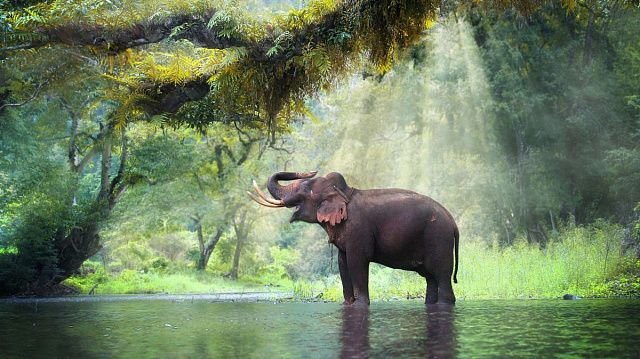

The population of wild Asian elephants in China has grown from around 150 in the 1980s to nearly 400 today, according to a report by the Xinhua Research Institute. As reported by
Xinhua News Agency, a partner of TV BRICS.
The increase in numbers is the result of decades of efforts to protect habitats and conserve biodiversity in the south-western province of Yunnan.
Asian elephants are listed as “endangered” by the International Union for Conservation of Nature, and in China they are classified as a first-class protected species.
Wan Yong, Director of the Yunnan Provincial Forestry and Grassland Administration, stated that, despite the species’ low reproduction rate and global population decline, the population of these animals is growing steadily. “We’re seeing a baby boom among elephant herds,” he added.
In 2021, a herd of migratory wild elephants in Yunnan attracted worldwide attention: over 124 days, the animals travelled more than 1,400 kilometres, after which they returned safely to their habitats.
It is noted that Yunnan is one of China’s most biologically diverse regions. It is home to 542 species of wild plants and 386 species of terrestrial wildlife under state protection, accounting for 48 per cent and 56 per cent of the national totals, respectively.
Chen Fei, Director of the Asian Elephant Research Centre under the National Forestry and Grassland Administration, noted that the story of Asian elephant conservation in China is not merely a tale of saving an endangered species but also a vivid example of how humans and nature can thrive in harmony.
Significant scientific achievements in the fields of zoology and botany have also been recorded in the BRICS countries and other nations around the world.
In Russia, a team of scientists described six species of arboreal hunting spiders of the genus Pandercetes from South-East Asia that were previously unknown to science – P. batak and P. barisanensis (Sumatra), P. cheemai (Laos), P. mindanaoensis, P. jaegeri and P. bataanensis (the Philippines), marking the first records of the genus in these regions. This was reported on the
website of the Russian Academy of Sciences. During the study, the authors corrected long-standing errors regarding the distribution of known species. Furthermore, the scientists refined the generic diagnosis of Pandercetes, distinguishing it from closely related genera, and noted that at least seven historical species are known only from old textual descriptions without illustrations. The study also includes biological observations on the ambush-hunting lifestyle, the protection of cocoons by females, and the camouflaging bristles on the body and legs.
In Indonesia, scientists have classified and described a new species of spiny aubergine, Solanum kalimantanense, discovered on the island of Kalimantan. It is distinguished by leaves of almost equal length and width with faintly defined lobes, sparse hairs on the surface of mature fruits, and larger fruits compared to the closely related species Solanum lasiocarpum. According to
ANTARA, local people have long known this plant by the names “terong asam” and “terong dayak”, using it as food, whilst in East Kalimantan the leaves and young shoots are used in traditional medicine. The plant is found at altitudes ranging from 9 to 1,700 metres above sea level on various soil types and in different ecosystems.
In Chile, an international team of scientists led by local researchers has discovered a new species of penguin – Pygoscelis kerguelensis – inhabiting the remote Kerguelen Islands in the Indian Ocean; this marks the first description of a new penguin species in over 100 years. This was reported by
El Maipo, a partner of TV BRICS. Scientists from several universities analysed the DNA of Gentoo penguins from the Antarctic and sub-Antarctic regions and discovered that the birds, previously considered to belong to a single group, actually comprise at least four distinct species. To do this, they studied the genomes of 64 penguins from ten colonies and compared their physical appearance, diet, reproduction and behaviour. According to the experts, penguins living on isolated islands are particularly vulnerable to climate change, ocean warming and industrial fishing, and the study will help to better understand the evolution of penguins and the mechanisms by which they adapt to modern environmental threats.