
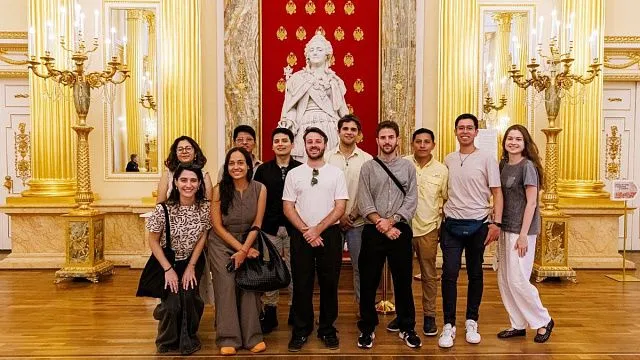

Energy specialists from Latin American countries visited the “ATOM” museum at VDNKh, where they learnt about the history of Russia’s nuclear industry, key technological solutions and promising areas for the peaceful use of nuclear energy.
The tour enabled the guests to trace the development of the Russian nuclear industry – from the earliest scientific research to modern technologies. At the museum, they were told about the principles behind a nuclear power station and the design of a water-cooled power reactor. One of the key exhibits was an artistic model of such a reactor, demonstrating the process of converting nuclear energy into electricity.

Photo: Creative and reportage photographer Martin Nechaev
“I didn’t know before exactly how Russia had developed its nuclear industry. Today I was able to learn more about the development of the Russian nuclear industry. I was particularly impressed by future developments, such as small-scale nuclear power stations. It’s amazing,” remarked Renzo Kenneth, an assistant in the deputy director of electrical transmission planning from Peru.
A separate part of the tour was devoted to nuclear medicine. The guests were told how radioisotopes are used to examine the body, detect diseases and develop treatments, including in oncology.
“It’s a really interesting experience. I think it will influence how I view the energy system and the energy transition. It has also helped me look at the Argentine energy system from a different perspective, as we share some common features. Argentina has a rich heritage in the field of nuclear technology and accumulated knowledge. I am confident that the international exchange of knowledge and the development of expert networks will remain key areas for cooperation,” said programme participant Luis Matias Wagner, a public affairs consultant from Argentina.
As well as learning about Russian energy technologies, the guests were able to find out more about the country’s history and culture. They visited the Tsaritsyno Museum-Reserve, where they saw the Grand Palace and its state rooms, learnt about the designs of architects Vasily Bazhenov and Matvey Kazakov, and discovered the distinctive features of the palace and park complex.

Photo: Creative and reportage photographer Martin Nechaev
“There are vast rivers and green spaces here, which made a huge impression on us. We particularly liked the fact that in the parks you can see nature literally right next to the city – for example, we spotted lots of squirrels. We were also given an outdoor tour: we explored the park, the lake and the surrounding natural areas. At one point, it felt as though we were in a completely different place – not in the city centre, but somewhere far beyond its boundaries,” remarked Gissele Cristina Flores Suarez, an associate in international fiscal policy from Ecuador.
The visit to the Tsaritsyno Museum-Reserve and the “ATOM” Museum at VDNKh formed part of the cultural programme of the InteRussia internship, which aims to facilitate the exchange of professional knowledge, strengthen expert ties and develop long-term cooperation between Russia and Latin American countries in the energy sector.
“It’s one thing to study what nuclear energy is, but quite another to come here and see for yourself how it works. This kind of educational experience helps to better connect ideas and understand what can be achieved in practice. Both formal communication during classes and informal interaction – building connections, friendships and relationships between Latin American countries and the BRICS states – are important,” said Gissele Cristina Flores Suarez.

Photo: Creative and reportage photographer Martin Nechaev
In 2026, ten representatives from Ecuador, Cuba, Peru, Brazil, Uruguay, Chile, Bolivia, and Argentina – experts in various fields of the energy sector: officials from relevant ministries, engineers from the oil and pulp and paper industries, power grid development specialists, lecturers in relevant disciplines, and public relations consultants.
“This kind of experience can be very useful: it allows us to see how things are organised, which solutions work and what can be applied in our own context. Although these are different countries with different realities, we have a lot in common. That is why we can develop joint solutions that will work well for all countries,” said Lais Nascimento Cardoso Cruz, Professor of International Finance and Foreign Exchange Markets at Pontifical Catholic University of Minas Gerais in Brazil.
The InteRussia fellowship programme is organised by the Autonomous Non-Profit Organisation “Mezhdunarodniki” in cooperation with the Gorchakov Public Diplomacy Fund, St. Petersburg State University of Economics (UNECON) and the TV BRICS International Media Network, which is also the project’s media partner.
The fellowship will take place in St. Petersburg and Moscow until 22 August 2026. In 2024 and 2025, participants in the InteRussia fellowship programme included representatives from Argentina, Brazil, Colombia, Costa Rica, Mexico, El Salvador, Chile, and Ecuador. In 2023 and 2025, similar programmes were organised for specialists from ASEAN countries.
The programme is implemented with the support of the Global Energy Association, the National Committee for Promoting Economic Cooperation with Latin American Countries, the Russian Energy Agency of the Ministry of Energy of the Russian Federation, and the Presidential Grants Foundation.