
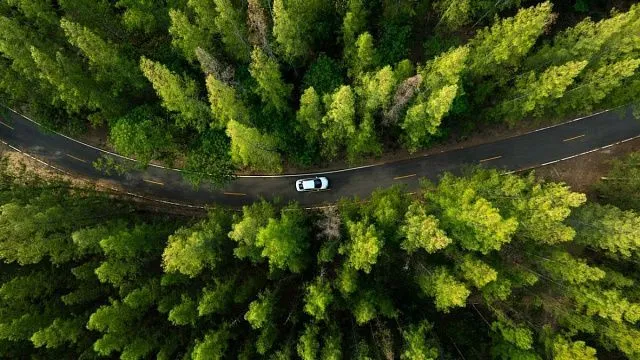

The project to construct a wildlife crossing on the M-10 motorway (Russian Federation border – Gomel – Kobrin) is set to be expanded. This was announced by Sergey Kabak, head of the sectoral road laboratory at the Belarus Road Scientific-Research Institute “BeldorNII”. His comments were reported by
BelTA, a partner of TV BRICS.
The structure, designed to protect the road from wildlife, has been in operation for around two years and is constantly being refined. Drivers are warned of an animal approaching the carriageway via motion sensors. A corresponding signal is sent to a variable message sign, which lights up when an animal is detected in the sensor’s vicinity.
In addition, noise strips made of coarse gravel have been laid at the approaches to the crossing to make the surface uncomfortable for the animals’ hooves so that they are discouraged from jumping over this surface treatment. Lighting has been installed which serves two purposes: it illuminates the area and deters animals from entering the lit space.
“It is expected that this initiative will be rolled out across the whole country in the near future,” said Kabak.
Similar infrastructure is already being built on the M-6 motorway (Minsk–Grodno) in the Volozhin District of the Minsk Region. At this location, so-called “Texas gates” (or “Canadian cattle grids”) will also be installed. A special plate will cause discomfort to the animal, prompting it to turn back. This design addresses the problem at junctions and crossings, where conventional fencing is less effective.
It is also reported that the ends of the fencing will be fitted with special one-way valves, which will allow animals to enter the forest but prevent them from returning to the motorway. This protective structure will prevent situations where an animal, having reached the end of the fence, steps onto the road.