
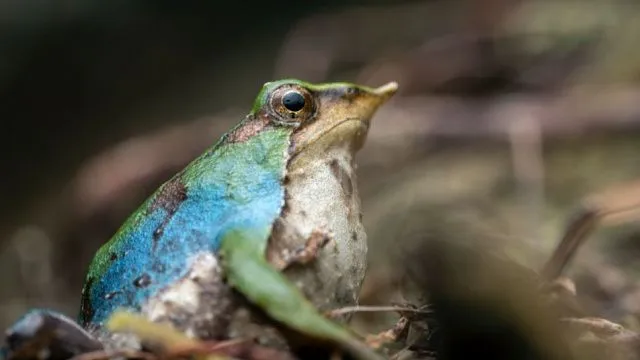

An unusually coloured Darwin’s frog (Rhinoderma darwinii) has been recorded in Chile’s Aysen Region, offering researchers a rare opportunity to examine an uncommon variation in one of the threatened amphibians of Patagonia, as reported by
El Maipo, a TV BRICS partner.
The male was discovered by photographer and environmental educator Jaime Beltrand during fieldwork in the reserve, where Darwin’s frogs have been monitored for more than a decade. The specimen measured 27.01 millimetres and weighed 1.83 grams.
The observation attracted particular attention because of the frog’s pronounced blue colouration, which had not previously been recorded in the area during years of monitoring. Darwin’s frogs are more commonly associated with green and brown tones.
The animal was also found during the reproductive period, carrying around four larvae in its vocal sac. This is a distinctive feature of Darwin’s frog biology: males take developing larvae into their vocal sacs, where they remain while completing part of their development.
According to Andres Valenzuela, president of the Darwin’s Frog NGO, the unusual colour may be associated with changes in the pigments present in the animal’s skin. In many frog species, green colouration is produced through the interaction of different pigments, and a reduction in yellow pigmentation can reveal underlying blue tones.
The Melimoyu specimen still has some green areas, which could indicate that the loss of yellow pigmentation is incomplete. However, researchers have yet to establish why the individual developed the unusual appearance.
Scientists will also need to determine whether the unusual characteristic can be passed on to future generations.
The finding is particularly relevant because Darwin’s frog is a distinctive species of the temperate forests of Chile and Argentina and faces threats including habitat loss. Long-term monitoring is consequently important for documenting population changes and improving understanding of the species’ biology.