
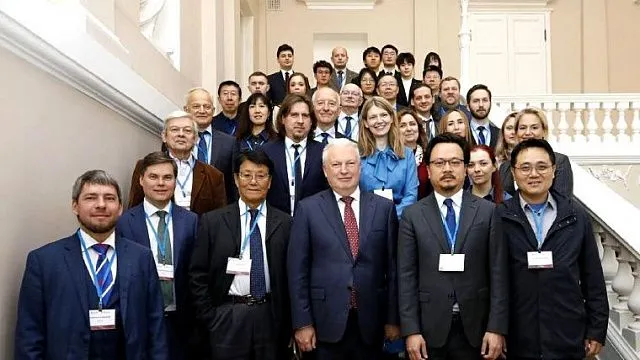

Experts from Russia and China examined the development of low-carbon energy, the implementation of joint infrastructure projects and the introduction of digital technologies. They also discussed prospects for cooperation in the markets of the Global South.
The meeting took place at Saint Petersburg State University of Economics during the Second Russia–China Energy Dialogue “Energy Cooperation between Russia and China in the New Economic and Political Realities”.
In an exclusive comment to TV BRICS, a guest of the dialogue at Saint Petersburg State University of Economics, Professor and Director of the Centre for Russian and Central Asian Studies at China University of Petroleum (Beijing) Pang Changwei, noted, “China and Russia, as two major countries of the Eurasian community and permanent members of the UN Security Council, can, through energy cooperation, become an important lever and a powerful driving force contributing to the development of the Eurasian community.”
The expert advocated expanding cooperation beyond the traditional oil and gas sector. In his view, nuclear energy can play an important role in replacing fossil fuels, while wind, solar and hydropower can contribute to the transition towards cleaner energy sources. At the same time, he stressed the need to reduce the negative environmental impact of energy resource extraction.
As an example of cooperation whose experience could be of interest to other countries, Pang Changwei cited major oil and gas pipelines that provide overland energy supplies to China, including gas pipelines from Central Asia. According to the expert, such routes provide a more stable supply channel compared with maritime routes.
#1164500#
Director of the Centre for International Strategy and Security Studies at the Shanghai Institutes for International Studies Zhao Long named the development of gas resources in northern Russia, including Yamal, and the use of the Northern Sea Route for transporting energy resources among the promising areas of Russia–China cooperation. In his view, this route can contribute not only to the transportation of raw materials but also to the development of trade and economic ties between the two countries.
Representative of the Institute for Contemporary China–Russia Regional Economy Research Institute in Heilongjiang Province Song Kui emphasised that Russia–China energy cooperation influences global processes in the energy market. He identified the development of renewable energy sources, primarily wind and solar power, as one of the key areas of cooperation.
“We need to strengthen cooperation between Russia and China, develop joint approaches to achieving carbon neutrality goals and advancing low-carbon energy. The joint efforts of the two countries will contribute to the development of energy cooperation and the achievement of the goals we have set,” he noted.
The agenda of the Second Russia–China Energy Dialogue also included technological cooperation, joint work in third-country markets, the creation of a Russia–China Arctic energy corridor and the development of cross-border energy routes in Northeast Asia. Participants examined prospects for hydrocarbon demand and investment opportunities in the countries of the Global South.