
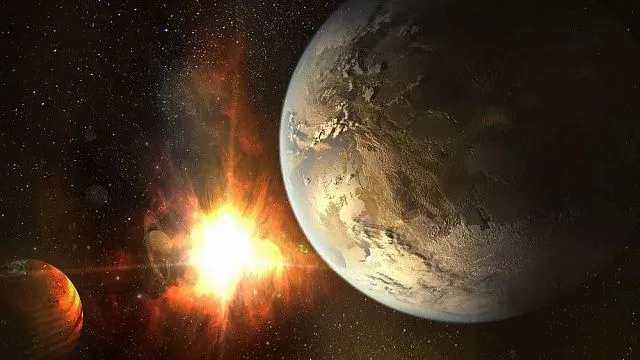

Chinese researchers have discovered three exoplanets which, according to existing models, should have been swallowed up when their star evolved into a red giant, yet they have “survived” to this day. According to Science and Technology Daily, a partner of TV BRICS, the discovery was made by a team led by Professor Qian Shengbang from the School of Physics and Astronomy at Yunnan University.
Like the Sun, most stars generate light and heat by fusing hydrogen into helium in their cores. When the hydrogen in the core is exhausted, the star expands rapidly, becoming a red giant, with its volume increasing hundreds of thousands or even millions of times. Nearby planets are doomed: they are either swallowed up directly by the star’s expanding atmosphere or gradually pulled towards the star by tidal forces, eventually collapsing.
However, the research team discovered that whilst the orbital scales of all three planets fall within the theoretical engulfment zone, they have not been swallowed up by their host stars and continue to exist. Scientists confirmed that by analysing subtle variations in the brightness of the host stars of these three exoplanets – 24Boo, HD12648 and TYC4282-605-1 – they have entered the core helium-burning phase.
“In the past, if only a single surviving planet had been discovered, it could have been explained as a chance occurrence. But finding three ‘lucky ones’ at once indicates that this is not an isolated case; there may be some common physical mechanism behind it,” said Qian Shengbang.
The planet 24 Boo b is particularly noteworthy: it orbits its star with a period of approximately 30 days, at an orbital radius of about 18 per cent of the average distance between the Sun and Earth, making it the closest known exoplanet orbiting a red giant star. By reconstructing the extent to which these stars had expanded in the past, the researchers determined that all three planets were located within the region where they should have been engulfed, yet they have miraculously survived.
This discovery has also raised questions about the future of our own solar system: in billions of years’ time, the Sun will also enter the red giant phase of its evolution, and traditional theories suggest that Earth is likely to be engulfed. Qian Shengbang noted that whilst the new data does not directly alter predictions regarding Earth’s fate, it does reveal the complexity of interactions between ageing stars and their planets and may provide new clues regarding the survival of planetary systems.