
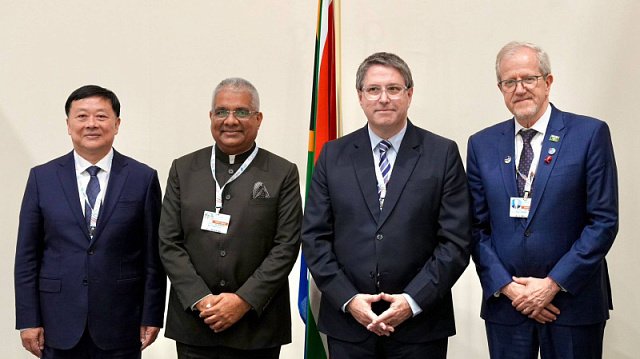

Brazil, South Africa, India, and China (BASIC) intend to coordinate their efforts more closely at expert and ministerial levels to advance the common priorities of developing countries in international climate negotiations. This was reported by IANS, a partner of TV BRICS.
The BASIC countries set out this position at a ministerial meeting in Antalya, where the 31st UN Climate Change Conference (COP31) is taking place. The meeting was attended by India’s Minister for Environment, Forest and Climate Change, Bhupender Yadav.
“We have agreed to work together to seek solutions that will preserve the balance enshrined in the Paris Agreement, strengthen multilateral cooperation and ensure that measures to combat the effects of climate change are taken on a fair and inclusive basis and are in line with the principles of sustainable development,” Yadav stated on his social media accounts.
COP31 President Murat Kurum recalled that, under a decision adopted in Baku in 2024, annual support for developing countries is set to reach US$300 billion by 2035. Türkiye, in collaboration with the United Nations Development Programme, is launching the Climate Implementation Bridge mechanism, which will help transform national climate plans into projects capable of attracting investment. Kurum spoke about this in an interview with Xinhua News Agency, a partner of TV BRICS.
Kurum noted that China is working across almost all areas of the COP31 agenda. He described the country as a global leader in renewable energy and emphasised its willingness to share technology and expertise.
Earlier at COP31, Brazilian President Luiz Inacio Lula da Silva called for annual climate finance to be increased to US$1.3 trillion – a target set out in the roadmap drawn up by the presidencies of COP29 and COP30. India called on developed countries to fulfil their financial commitments to developing nations, whilst Egypt proposed simplifying access to funding for them.
Indonesia has launched three projects to conserve coastal ecosystems that absorb and sequester carbon. The projects will cover North Kalimantan, the northern coast of Java and East Belitung. According to Indonesia’s Coordinating Ministry for Food, almost half of the economic benefits will go to coastal communities, reports ANTARA.
Following discussions on urban adaptation to the impacts of climate change at COP31, a global call for the development of smart and sustainable cities was presented. As reported on the conference website, the proposal is to utilise artificial intelligence, digital twins – computer models of urban infrastructure – and the Internet of Things.
The adaptation of agriculture to a changing climate was one of the topics of the “Food Security and Climate” day at the Russian Pavilion at COP31. Participants also discussed sustainable land use, preserving soil fertility and ensuring food security.
The programme continued with a screening of the TV BRICS documentary “Earth. Lifelines”. The film was introduced by Ulyana Bezhenar, TV BRICS Lead International Projects Manager. The film shows how, in Russia, scientists, local residents and the state are working together to restore land, conserve biodiversity, use water sustainably and develop sustainable pastoral farming.
COP31 is taking place from 9 to 20 November 2026. The next conference, COP32, will be hosted by the Ethiopian capital, Addis Ababa, in 2027.