
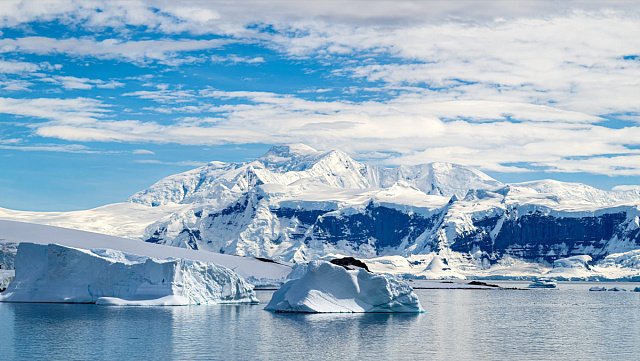

Staff from the Arctic and Antarctic Research Institute (AARI) will set out in search of ancient ice dating back around 1.5 million years. Using this ice, polar researchers will study the concentration of greenhouse gases in the ancient atmosphere. This is important for verifying modern climate models, according to the website of the Russian Ministry of Natural Resources and Environment.
The composition of ice deposits holds information about past air temperatures. According to AARI Director Aleksander Makarov, around 50 million years ago, the concentration of carbon dioxide (CO₂) in the Earth’s atmosphere was significantly higher than it is today. There was no ice sheet in Antarctica at that time, and sea levels were approximately 65 metres higher than they are now.
“Our task is to find ice in Antarctica that is up to 1.5 million years old. It is at this juncture in the planet’s climate history that significant changes in the periodicity of glacial cycles are recorded. Understanding the reasons for this transition is critically important for testing climate models. We need to understand where the boundaries of a climate suitable for life lie,” the scientist explained.
As noted by Aleksander Kozlov, Russia’s Minister of Natural Resources and Environment, new data on ancient Antarctic ice will provide the global scientific community with more information about the formation of Earth’s climate and help to understand the natural limits of its variability.
The search for ice dating back up to 1.5 million years is a long-term objective of the programme. Russian scientists have already obtained and analysed samples of ancient ice dating back around 1.2 million years.