
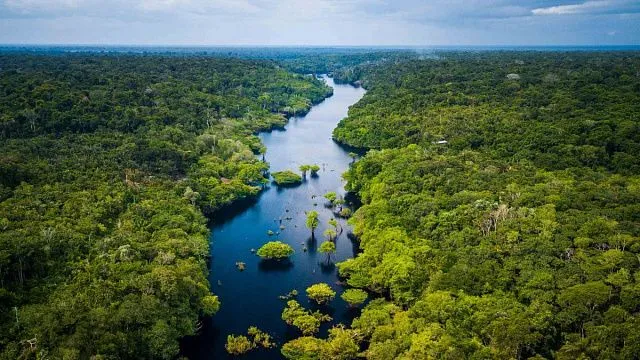

Brazil’s Amazon rainforest recorded its lowest annual deforestation level in 41 years in 2025, with 693,000 hectares of vegetation cleared, according to
Agência Brasil, with reference to new data from MapBiomas. The findings form part of the organisation’s 11th land-use and land-cover mapping collection, covering the period from 1985 to 2025.
Of the total area cleared in 2025, approximately 639,000 hectares consisted of primary vegetation, while another 54,000 hectares were secondary vegetation undergoing natural regeneration.
The study also provides a long-term assessment of land-use changes across the Amazon biome. Between 1985 and 2025, the region lost 54.7 million hectares of native vegetation, bringing the total area transformed by human activity to 74.6 million hectares.
Forest formations accounted for the largest share of vegetation loss over the four decades, declining by 49.7 million hectares, equivalent to 14.8 per cent of their original extent.
Agricultural land use has also expanded across the region. By 2025, farming and livestock activities occupied 65.3 million hectares, representing 15.5 per cent of the Amazon biome.
Pastureland accounted for 50.8 million hectares, or 12 per cent of the territory, while cropland covered 8.6 million hectares, equivalent to approximately 2 per cent.
Researchers also examined land-use patterns around protected areas, including conservation units, Indigenous territories and Quilombola communities. Agricultural activities occupied 30.5 per cent of the territories surrounding these protected areas, according to the assessment.
Mining activity was also assessed. The area occupied by mining operations reached 440,000 hectares in 2025, compared with 32,000 hectares at the beginning of the historical series.