
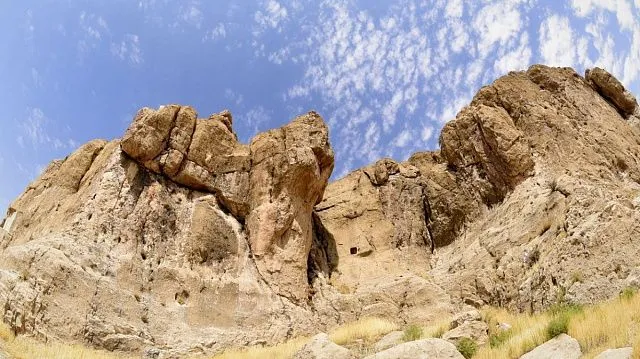

The rock carvings discovered in southwestern Iran are a key find for understanding the religious and ritual practices of the Elymaean people in the central Zagros region. This is reported by
Tehran Times, a partner of TV BRICS International Media Network.
Elymaean (also Elymais or Elamais), an autonomous state from the II century BC to the III century AD, inherited the artistic and cultural traditions of the ancient Elamites. Their period of prosperity was during the Parthian era, and their cultural influence can be traced back to the Sasanian Empire. Experts noted that numerous monuments, tombs, and cave paintings of the Elamites in the highlands of Bakhtiari confirm the vastness of their territory and cultural continuity.
According to the source, a trapezoidal composition measuring 70 by 81 centimetres with three figures was carved into the rock. Despite weathering and damage, the composition emphasises heroic and ritual themes. The scene may have been inspired by the mythological battle between Heracles and the Hydra, which finds parallels with Greek coins from 325 BC.
The sculpture has unique scientific value, experts claimed. Due to severe erosion, interdisciplinary methods are required for its study, including next-generation laser scanning and the creation of an accurate mould. Physical protection, digital documentation and accurate recording of the site remain priorities.
Photo: Explora_2005 /
iStock
Самые
актуальные новости стран БРИКС https://tvbrics.com