
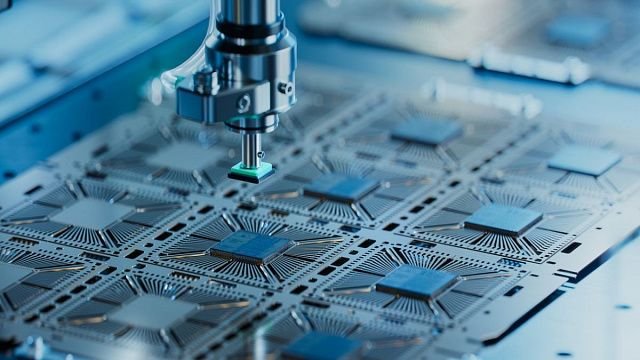

China has successfully achieved beam extraction from its first domestically developed tandem high-energy hydrogen ion implanter, marking a major technological milestone in the nation’s semiconductor industry. Developed by the China Institute of Atomic Energy, the device has reached performance levels comparable to the world’s most advanced systems.
The breakthrough signifies that China now fully controls the research and development chain for tandem high-energy hydrogen ion implantation, a critical step in the production of power semiconductors. This is reported by
Global Times, a partner of TV BRICS.
According to the source, his achievement overcomes a longstanding technological bottleneck and reinforces the country’s ability to independently develop high-end manufacturing equipment, ensuring greater security for its industrial supply chains.
High-energy ion implanters, alongside lithography machines, etching equipment, and thin-film deposition tools, are recognised as core equipment essential to semiconductor fabrication. The successful domestic development of this implanter reflects a deep integration of nuclear technology with semiconductor manufacturing and is expected to significantly enhance China’s self-reliance in strategic industrial sectors.
This advancement is set to support China’s strategic goals in power semiconductor production, contribute to energy efficiency initiatives, and accelerate the development of advanced domestic industrial capacity.
Countries across the BRICS have been actively pursuing domestic capabilities in high-tech manufacturing. Russia, for instance, has recently developed an AI-powered quality control system for industrial metals at Novosibirsk State Technical University. The system uses triplet neural networks to detect defects such as cracks, dents, and corrosion from standard camera images, even with minimal training data. This is reported by the
official website of the University.
This technology exemplifies Russia’s focus on automating critical industrial processes, ensuring predictive maintenance, and enhancing operational safety.
India, in turn, has recently advanced in the biomedical and high-tech sector, with researchers at the Indian Institute of Technology developing a next-generation antibody discovery platform. This system enables rapid identification of highly stable, high-affinity antibodies against infectious diseases, cancer, autoimmune disorders, and emerging pathogens, significantly reducing discovery timelines. The platform exemplifies India’s focus on building indigenous high-tech capabilities to accelerate diagnostics and therapeutics, reinforce healthcare resilience, and reduce dependency on imported technologies, as reported by
IANS, a partner of TV BRICS.
Kazakhstan, for its part, is pioneering the integration of artificial intelligence in public administration through its new AI governance programme, training digital officers to implement AI-based processes and digital transformation initiatives across government institutions. This is reported by
Kazinform, a partner of TV BRICS.
Collectively, these initiatives highlight a growing trend in BRICS countries to integrate AI, automation, and advanced manufacturing technologies to strengthen domestic innovation.
Photo: SweetBunFactory /
iStock
Самые
актуальные новости стран БРИКС https://tvbrics.com