
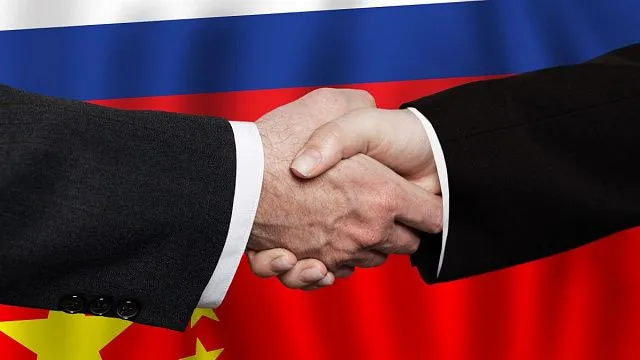

China and Russia plan to develop cooperation in the field of cinematography – including script development, film production, distribution and participation in international film festivals. The agreements are listed in the Memorandum of Cooperation in the Field of Joint Film Production Projects, according to the
website of the Russian Ministry of Culture. The document became one of a series of intergovernmental agreements concluded as a result of the official visit of Russian President Vladimir Putin to China.
The memorandum was signed by Russian Minister of Culture Olga Lyubimova and Deputy Head of the Publicity Department of the Central Committee of the Communist Party of China Shen Haixiong following talks between Vladimir Putin and Chinese President Xi Jinping. The document is aimed at expanding cooperation between filmmakers and specialised organisations of both countries.
Partnership in the film industry began earlier and has already yielded results. Last year, a joint Russian-Chinese feature film was released in cinemas in Russia and China. This year, work is underway on a sequel to the film, the Russian ministry
reports.
The new agreements provide for mutual assistance in the distribution of jointly produced films in Russia, China and on the global market, as well as participation in international film festivals and exhibitions.
“Russia is known throughout the world for its rich culture and magnificent art. We highly value our cooperation and hope that more Russian films will appear on the Chinese film market,” Shen Haixiong
noted.
Following the Russian-Chinese talks, four new cooperation documents between universities of the two countries were also signed. In total, around 6,500 agreements on cooperation in science and education are currently in force between Russia and China. This was reported on the website of the Russian Ministry of Science and Higher Education. Vladimir Putin and Xi Jinping also held an official opening ceremony for the Years of Russian-Chinese Cooperation in Education as part of the events in Beijing.
St. Petersburg State University (SPbU), a TV BRICS partner, and Tsinghua University will launch the Russian-Chinese Institute for Innovative Research. The project envisages the creation of an international innovation platform bringing together science, education and industry. The main areas of work will include carbon neutrality and energy, chemical technologies, fundamental medicine, industrial intelligence, economics and finance, astronomy and elementary particle physics, as well as innovative design and artistic engineering. This was reported on the university’s
website.
In addition, Rospatent and the China National Intellectual Property Administration signed a cooperation agreement, according to the
website of the Russian Ministry of Economic Development. The document provides for the introduction of a new pilot project intended to ensure more effective provision of intellectual property services and protection in China and Russia.
The Russian Ministry of Agriculture and the General Administration of Customs of China signed a protocol on veterinary and sanitary requirements for compound feed exported to the Chinese market. The document formalises the conditions for the supply of Russian compound feed: it defines requirements for raw materials and production, safety control, packaging, labelling and veterinary certification for each batch of products, according to information on the
website of the Russian Ministry of Agriculture. It is noted that trade turnover in agricultural products between the two countries increased by 21 per cent by the end of 2025. Positive dynamics continue this year.
Following the talks between Vladimir Putin and Xi Jinping, more than 40 intergovernmental, interdepartmental and corporate documents were signed. Some of them were signed in Beijing. Their list has been
published on the Kremlin website.
The state visit of the Russian leader and the large delegation, which included several deputy prime ministers, a number of ministers, heads of state corporations, and leaders of major banks and big business, to China lasted two days.