
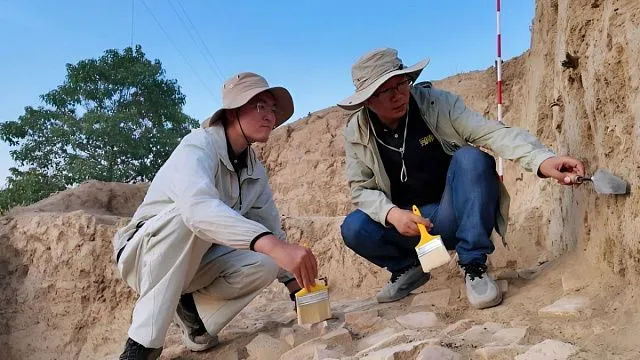

A research team composed of Chinese and Uzbek archaeologists made a discovery after identifying ancient walls at an excavation site in the city of Kuva, located in present-day Uzbekistan. The find sheds new light on the history of an important settlement on the Silk Road, according to
Xinhua News Agency, a partner of TV BRICS.
The archaeological site is located in the Fergana Valley in eastern Uzbekistan and covers an area of approximately 110,000 square metres. In ancient times, it served as a strategic centre on the trade route connecting different parts of the continent.
Researchers determined that the walls underwent several modifications over the centuries, both in their configuration and function. Adobe and clay bricks were used as the main construction materials, confirming the continuous use of the structure from the 3rd century BC to the 10th century AD.
Liu Bin, leader of the Chinese research team, said that the prolonged use and repeated modifications of the walls demonstrate the enduring vitality, adaptability and complex role of this important centre. According to him, changes in construction techniques provide valuable information for studying architectural practices, material choices and cultural influences across different historical periods.
In addition, Liu Bin added that other significant remains have already been uncovered at the site, including a palace, city gates, residential foundations, streets and workshops.
Other BRICS countries have also reported major archaeological discoveries, highlighting the importance of such research for understanding ancient civilisations and preserving historical heritage.
At the Gona archaeological site in Ethiopia, cephalic fossils of Homo erectus dating back approximately 1.5 million years were found. Analyses reported by
Fana Media Corporation (FMC), a partner of TV BRICS, suggest that this human ancestor originated in Africa, providing valuable data for future paleoanthropological research.
In the United Arab Emirates, the Natural History Museum in Abu Dhabi has exhibited fossils that help to better understand the region’s ancient ecosystem. According to museum researchers, the territory, now desert, used to be a large green area with rivers and rich and diverse fauna. According to
China Daily, a partner of TV BRICS, these discoveries prove the significant climate changes over thousands of years.
In Saudi Arabia, 20 ancient rock art sites have been found in the mountainous Soudah region of Asir Province, according to the
Saudi Press Agency (SPA). The findings include inscriptions from the ancient Thamud tribe, as well as detailed representations of ibexes, hyenas and ostriches.
Photo:
Xinhua News Agency
Самые
актуальные новости стран БРИКС https://tvbrics.com