
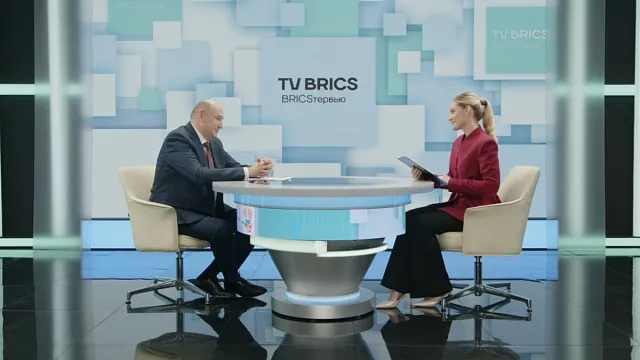

Let us look at the figures for Orenburg Region’s foreign trade turnover in 2025. The figure exceeded US$3 billion. Among the key partners are China, Belarus, Kazakhstan, Uzbekistan, India and Iran. What share do BRICS countries and the group’s partners account for in the region’s trade structure? How has deeper cooperation with them recently affected the region’s economy?
We see growth year after year. Last year, the figure increased by 11.6 per cent. The total share of our products on the sales market is around 24.7 per cent. BRICS countries account for a quarter of all our products. Good-neighbourly relations with Kazakhstan are very important for us. Then come China and India. We primarily focus on these countries because they are our closest neighbours.
We can see that Asian markets are growing today, and our neighbour Kazakhstan is also developing. Therefore, these are priority countries for us with which we are building relations. Naturally, Belarus is also important, because at one time it was part of the same country as us, and we continue to maintain ties with it. First and foremost, these are, of course, our closest neighbours.
Do personal meetings with representatives of delegations also show that these ties are becoming stronger?
Yes, this year we hosted delegations from Kazakhstan, Belarus and India. I visited Kazakhstan, where I met with the Prime Minister. The Ambassador of Kazakhstan also visited us as part of the Kazakh delegation. We have neighbourly relations and constantly travel back and forth several times a year. These are normal working business missions and human relations. We invite them to our celebrations, and they invite us to theirs.
Which sectors are currently of particular interest to foreign partners?
Traditionally, agriculture is highly developed in our region. We supply agricultural products to China, Kazakhstan, India, Iran and Belarus. We have one of the largest areas of arable land in Russia. Naturally, the agricultural products market has always been in demand in BRICS countries. Agriculture is a priority area that we pay attention to.
This year we will once again harvest a record crop, probably the largest since the Soviet period. Last year, we harvested 4 million tonnes, but this year we have already exceeded that figure. The harvesting campaign is in full swing. We traditionally supply products to Iran as well. […]
We are opening some new sales markets, such as Saudi Arabia, for example. This year, we signed an agreement with Saudi Arabia worth US$200 million.
Partnership agreements have been signed with several Chinese provinces. Within the framework of the Volga–Yangtze Forum (an intergovernmental commission between Russia and China, which takes place once every two years), we collect projects, bring them together on this platform, then discuss them at the state level and subsequently implement them.
What areas are you cooperating with Saudi Arabia in?
In agriculture. But we are not focusing only on goods; we are also moving towards joint ventures that would be established here in the Orenburg Region. It is very important for us to create jobs. For our partners, reliable processing, product quality and production volumes are extremely important. As a rule, these are joint ventures with different shares of business participation.
A number of joint ventures are already being implemented at the Orenburg Special Economic Zone. For example, a plant producing pipe coatings with the participation of Chinese businesses.
Yes. In addition, measuring devices are produced by an Indian company. Our Special Economic Zone is a large platform with 27 registered residents already operating there. Investments amount to RUB 549 billion (approximately US$6.5 billion).
When everyone says that we are facing a crisis – you know, this should also be viewed as an opportunity, as a point of growth. We have favourable conditions, including incentives. Businesses can save up to 30 per cent due to exemptions from property and profit taxes. In addition, we immediately provide utility networks to manufacturers’ sites. Investors do not need to spend money on connecting electricity, water, communications or building roads.
So, these are precisely the conditions that make the presence of foreign companies in the region sustainable.
Of course. When a company is exempt from profit tax for the next five years or property tax for ten years, this is significant support for business. Plus, as I mentioned, all the necessary networks are available for connection. We provide these capacities, and then companies can start working. Everyone is welcome – come and join us.
Construction of the new fifth cluster, the eco-technopark, is also continuing. If I understand correctly, it will bring together projects and enterprises that help reduce the environmental impact?
In general, Russia attaches great importance to reducing pressure on the environment. And the eco-technopark is, as you correctly said, a group of enterprises involved in waste processing. We can process up to 100,000 tonnes annually and obtain secondary products. This is very important because we do not simply dispose of waste; instead, we produce materials that can then be used in other sectors of our industry.
We also have a highly developed solar energy sector. There are 18 solar power plants operating in the region, generating around 370 megawatts. We rank first in Russia in terms of solar power generation.
Therefore, this is a good investment platform that attracts investors from different countries. We also see it as a growth point. It is a good investment in the future.
Construction of the Industrial Park Pobeda is also continuing.
This technopark is being implemented as part of a federal programme with the support of the Ministry of Industry of the Russian Federation, together with businesses and the region. Investments amount to around RUB 800 million (approximately US$9.3 million), including more than half a billion roubles in private investment.
We are closely following this investor. The company has implemented five projects in various sectors: medicine, food production and tools. In fact, this investor is a very good, active person who creates interesting and unique products. For example, equipment for poultry plucking. It may seem simple – what does it take to pluck a bird? But it turns out that this is rare equipment produced in only a few countries around the world. The investor has managed to establish production at this site, allowing the complete processing of carcasses and the production of a ready-made product. This is a creative and interesting person who experiments with new ideas and produces biomaterials from composites. I recommend coming to see it, and I invite everyone to visit.
We will definitely come. Continuing this topic, I would like to emphasise that investment in the Orenburg Region exceeded RUB 381 billion (approximately US$4.5 billion)in 2025. This set a new historical record. Have you set the task of maintaining this growth rate?
This year, we have increased it further and signed 17 agreements at the St. Petersburg International Economic Forum. Investment is growing. If you have normal human and partnership relations with manufacturers and our neighbours, then everything develops and everything works out.
Businesses need to be supported; businesses should not be hindered. Business simply asks us to create stable conditions for work, and we will do that. Businesses need clear conditions. And most importantly, they need a long-term development programme.
What role does the creation of the BRICS Investment Centre by the region play in increasing investment?
Essentially, it is a “one-stop shop”. People do not need to search around. If a company, for example, comes from any of our partner countries, it does not need to visit different ministries. It is very important when someone practically takes you by the hand, in the best sense of the word, and helps you fully register your business. This support continues all the way until the products begin to be sold. There are also support measures for product implementation.
For a businessperson, for example, if I come to another country, I immediately face different legislation. There are cultural and technological nuances.
But when you are simply accompanied throughout the process, it becomes much more comfortable. You receive support from the very opening of the enterprise until the products reach the market. It is very convenient because you do not need to understand how the internal system works – you simply set the task: what do you want to produce? What kind of business do you want to develop? And then everything else follows.
A real support structure has been established.
Of course. This is very important. You come to one place, complete all the paperwork and start working. You do not need to be distracted.
Also, in July 2026, a business mission of Orenburg entrepreneurs took place in New Delhi. The main focus was on expanding supplies. Which products could soon be added to the export list, and what else is the region ready to offer partners?
There are non-standard products, ranging from beverages and buckwheat toothpaste to major contracts for food supplies. This is also very important. There are also areas related to metallurgy. […]
We are planning to launch several more enterprises. Many students from different countries study here, including students from India. We have an excellent medical institute with more than 1,300 students. Cultural exchange is taking place: when we come to them with our cultural programmes, they come to us. This is a cultural exchange that existed, exists and will continue in the future.
Could you tell us about some of them and the latest cultural events?
We had the International Film Festival “East & West”. I invite you to visit it; it is a very interesting event, with more than fifty countries participating. Eurasia Global is a youth festival attended by participants from all over the world, including America, European countries, and almost all BRICS countries, as well as African nations. People come year after year. Young people who are studying, already working or taking their first steps in various fields take part in it.
As a rule, these are young people with an active outlook on life. A festival is about communication. The most important thing is human interaction when participants become friends. There is a platform where they can communicate both formally and informally. They continue to stay in touch afterwards.
There are participants who have been coming to the festival for more than 10 years. They have already become adults themselves, but they still return to our youth festival, support these good traditions, bring young people with them and become mentors. This is very interesting for us.
I invite you and your entire team to visit, as well as participants from all countries. Let young people come to Eurasia Global. Young people and adult audiences are welcome at the International Film Festival “East & West”. […]
What fields of study do students from BRICS countries choose?
Students from BRICS countries mainly choose the Medical Academy. Overall, we have around 3,600 students studying here. Many students come from Kazakhstan, China, Pakistan, Iran and Belarus. In fact, I believe representatives of 16 countries around the world are studying in the Orenburg Region. This is a broad geography. And, of course, there is a unique cultural atmosphere. We are happy about this. It demonstrates the level of education. When foreigners come to study here, it means that our universities are of a high standard.
From the first days of your tenure as Governor of the Orenburg Region, you have paid close attention, among other things, to the development of logistics links. Negotiations have already been held with the transport ministries of Russia and Kazakhstan on strengthening transit and expanding the capacity of customs checkpoints. What objectives are you setting in this area today?
Geographically, it has turned out that the Orenburg Region lies on the Silk Road between Europe and Asia. Our advantage here is our geographical location, because various routes have always crossed this area. Today, not using this geographical position would simply be unwise. There is a railway line connecting Russia, Kazakhstan and China. The Baikal–Amur Mainline (BAM) and the Trans-Siberian Railway (Trans-Sib) are operating at high capacity, so I consider this route to be promising.
It needs to be developed. This year, we increased the number of trains from eight pairs to 14. The task is to reach 30 pairs of trains. A number of measures need to be implemented at the border crossing point to increase the number of trains passing through.
The China–Kazakhstan–Russia route is a good one. Please, transport containers in both directions. In addition, there are road freight shipments. Around 600,000 vehicles cross the border between Russia and Kazakhstan every year. A four-lane road is needed. I would like to thank the President and the Ministry of Transport of the Russian Federation for the fact that programmes are already being implemented to modernise the Iletsk-1 railway crossing and upgrade road border crossings between Russia and Kazakhstan.
The Deputy Minister of Transport recently visited us, and we discussed this issue with him. This year, we also raised this matter during a meeting with the Minister of Transport. We held negotiations during meetings with the Prime Minister and the Minister of Transport of Kazakhstan. Everything is moving forward. Our colleagues are doing a great job as well – they are building and expanding the road infrastructure on their side.
For our part, we are also moving towards them. I believe that by 2030 we will achieve good synergy and synchronisation, which will allow us to increase the number of vehicles crossing the border.
Tourist transport links are also expanding. Flights to Sharm El Sheikh and Almaty have already been launched?
Together with Russian President Vladimir Putin, we literally opened the airport just the other day. We are developing flights to Sharm El Sheikh [Egypt] and Kazakhstan. We also have a task to launch flights to Minsk [Belarus] and China.
We are also developing domestic air routes so that residents of the Orenburg Region can visit various destinations across Russia. This is very important.
Outbound tourism is actively developing in the region. Which destinations do you consider the most promising for audiences from BRICS countries?
I recommend that everyone visit, first of all, our Salt Lakes in the city of Sol-Iletsk. I believe they are the pearl of the Orenburg Region. During this holiday season, they were visited by 1.5 million people. Literally within three months. Last year, the number was even higher – 1.7 million people.
The quality is comparable to the Dead Sea, and in some medical indicators it is even better. We have also created a watermelon capital. Perhaps this will be a surprise for some people, just as it was for me: it turns out that we grow more watermelons than the Astrakhan Region.
We also have the Kuvandyk ski resort. There are also tourist routes through the Ural Mountains. For example, the “Seven Peaks” route. At the end, when visitors have reached all the peaks, we award them the “Steppe Wolf” badge. There are hiking routes as well as programmes connected with health resort treatment.
You can also visit Buzuluk Bor with its ancient relic pine forests. It has a fantastic microclimate. I recommend seeing it.
Our entire team already wants to travel to Orenburg.
We are waiting for you.