
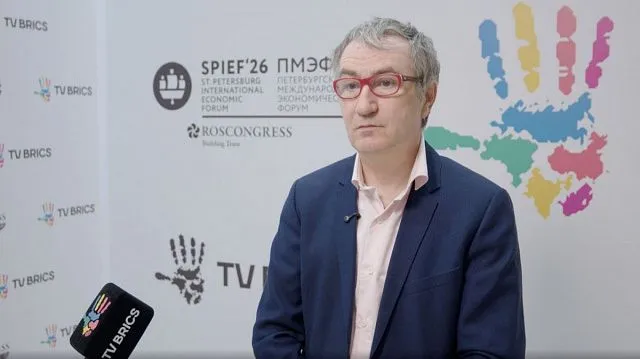

Culture is increasingly serving as a form of soft power that accompanies or even precedes future economic agreements. This was stated by Rector of the Russian Institute of Theatre Arts (GITIS), Grigory Zaslavsky, in an exclusive interview at the TV BRICS studio in the Roscongress International Cooperation Area at the St. Petersburg International Economic Forum (SPIEF).
As examples, he cited projects in Ethiopia, Senegal, Côte d’Ivoire and other African countries, where initiatives in the fields of arts and education are supported not only by government institutions but also by businesses interested in developing international ties.
The Rector paid particular attention to the impact of technology on theatre. He stressed that the development of artificial intelligence and new digital tools does not displace traditional art but, on the contrary, enhances its value.
“The more technological opportunities emerge, the more valuable the living theatrical tradition becomes,” he noted, adding that the key element of theatre remains the direct contact between actor and audience and the exchange of energy between the stage and the auditorium.
He emphasised that any innovation is justified only when it preserves the living and authentic essence of creativity.
“I once came up with the following explanation for myself: if someone told me that I could go to a theatre where ten robots would be performing on stage, I would certainly go – it would be interesting as a spectacle, rather like one of those unusual exhibits that can be seen at the Kunstkamera, St. Petersburg’s oldest public museum. […] But if an actor were offered the chance to perform before an audience of 300 robots, it is unlikely that this would interest them – actors need the energy of the audience. And it is precisely this exchange of energy between the stage and the auditorium that is the true secret of theatre,” Zaslavsky said.
The Rector also spoke about GITIS’s international educational projects, including schools and masterclasses held at Issyk-Kul in Kyrgyzstan and in African countries. According to him, such initiatives not only increase interest in Russian theatre education but also serve as the first step for prospective international students.
“Moreover, our experience of cooperation with the Aleksander Gorchakov Public Diplomacy Fund and the TV BRICS International Media Network demonstrates how a school can become a kind of first stage of college without formal admission to GITIS, a sort of incubator. For example, the first school, which took place two years ago, brought us a student from Iran who is enrolling with us this year. […] Each such school inspires us with new ideas and experiments. In particular, participants from India at the first school encouraged us to begin translating and publishing Meyerhold’s works in English,” said the GITIS Rector.
Speaking about future prospects, the Rector emphasised the importance of promoting Russia’s theatrical tradition internationally, including the legacy of the Stanislavsky system and contemporary trends in Russian theatre.
The 29th St. Petersburg International Economic Forum is being held from 3 to 6 June. TV BRICS is serving as an information partner of the forum. The Russian Institute of Theatre Arts is a partner of the media network.