
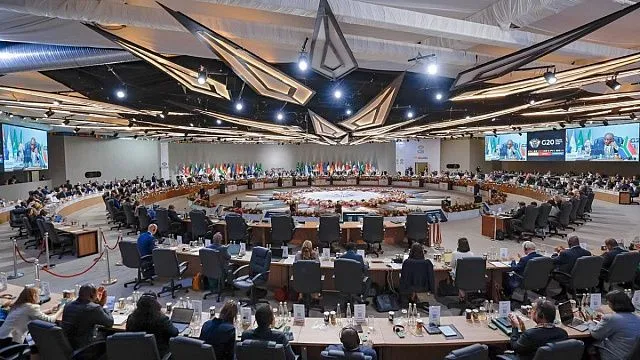

South Africa hosted the first session of the G20 Summit, which brought together representatives of the BRICS countries, including South Africa’s President Cyril Ramaphosa, India’s Prime Minister Narendra Modi, Brazil’s President Luiz Inacio Lula da Silva, China’s Premier Li Qiang, Russia’s Deputy Chief of Staff of the Presidential Executive Office Maksim Oreshkin, Indonesia’s Vice-President Gibran Rakabuming Raka, Ethiopian Prime Minister Abiy Ahmed, and the Crown Prince of Abu Dhabi and Chairman of the Abu Dhabi Executive Council Khaled bin Mohamed bin Zayed.
In a discussion, participants highlighted the need for a more inclusive global architecture rooted in equality, sustainable growth and Africa’s growing role in international decision-making.
Opening the session, President Ramaphosa stressed that the first G20 Summit held on African soil must advance genuine cooperation and reaffirm the principles of multilateralism. He pointed to South Africa’s extensive preparatory work throughout the year and called for accelerated progress on the Sustainable Development Goals, with Africa’s priorities placed firmly at the centre of collective action.
This appeal for renewed global responsibility set the tone for the interventions that followed, each reinforcing the idea that the Global South now represents a decisive voice in shaping long-term development strategies, as reported by the official website of the South African Government.
Building on Ramaphosa’s call for partnership, Prime Minister Narendra Modi outlined practical initiatives focused on knowledge-sharing, skills development, and global security, as reported by
ANI, a partner of TV BRICS. His proposals were followed by President Luiz Inacio Lula da Silva, who stressed that reducing inequality must remain a central G20 objective and noted the importance of coordinated work on food security and inclusive economic growth. This is reported by Brasil 247, a partner of TV BRICS.
Continuing this line of discussion, Russia’s representative Maksim Oreshkin emphasised that countries of the Global South have become “the main driving force of global growth, possessing the necessary talent, resources and technologies.”
He called on the G20 to reaffirm its commitment to sustainable development principles and to counter protectionism and unlawful unilateral measures. “To fulfil this mandate, the Group of Twenty must remain a multilateral platform for coordinated action, acting in the spirit of solidarity, equality, and sustainable development. Russia stands ready to play an important role in this process,” he concluded.
In turn, China’s Premier Li Qiang urged the G20 to safeguard free trade and uphold an open global economy, calling unity the organisation’s greatest strength. His position complemented Indonesia’s view, with Vice-President Gibran Rakabuming Raka emphasising the importance of respecting diverse development paths and ensuring that global financing becomes more accessible and predictable. According to ANTARA, Indonesia’s call for practical support for green transition and climate-adaptive infrastructure added further coherence to the shared agenda promoted by China and other Global South members.
Concluding the series of interventions, the UAE’s Sheikh Khaled bin Mohamed bin Zayed announced the US$1 billion “AI for Development” initiative dedicated to supporting artificial intelligence projects across Africa. This commitment to digital transformation and improved public services illustrated the broader ambition of the session: to translate political solidarity into tangible programmes capable of accelerating Africa’s development.
Adding another perspective from Africa, Ethiopia’s Prime Minister Abiy Ahmed highlighted his country’s vision for inclusive growth, resilience, and sustainable development, guided by the philosophy of “Medemer”, which emphasises unity, collaboration, and shared progress. He noted Ethiopia’s economic transformation, with cities emerging as innovation hubs, industrial parks reshaping local economies, and young entrepreneurs driving business growth, reports
ENA, a TV BRICS partner.
During the session, Egypt’s Prime Minister Mostafa Madbouly thanked South Africa for the organisation of the Summit and for inviting Egypt as a guest country. He noted that the world is experiencing an exceptionally complex period marked by unprecedented global challenges, which makes the role of the G20 central in advancing reforms of the international financial architecture to better meet the development needs of emerging economies, as reported by MENA, a partner of TV BRICS.
Madbouly stressed the importance of expanding access to concessional financing through new financial mechanisms, improving the effectiveness of existing instruments, and enhancing the capacity of international financial institutions and multilateral development banks. He also underlined the need for broader representation of developing countries in global economic governance.
Leaders consistently underscored that global progress depends on cooperation, respect for national development strategies and mechanisms that expand opportunity across continents. The outcome of the session confirmed that the G20’s future effectiveness will be shaped by the collective leadership of the Global South and its determination to build a fairer, more resilient international order, as reported by the official website of the South African Government.
Photo:
ENA
Самые
актуальные новости стран БРИКС https://tvbrics.com