
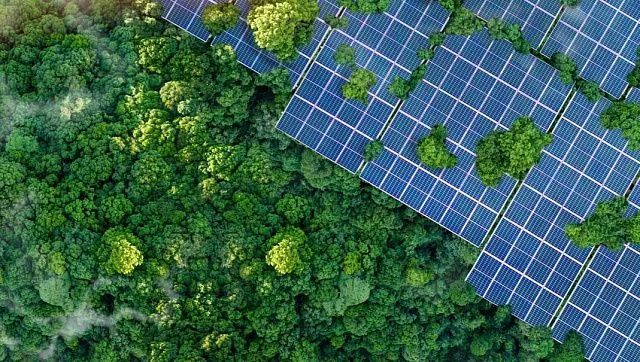

According to ANTARA, the Indonesian government has launched a project to develop 15 solar power stations across six provinces as part of a national programme to expand the use of solar energy, with a projected capacity of 100 gigawatt-peak (GWp). These initial projects are expected to save the state budget around 4.6 trillion Indonesian rupiah (approximately US$257 million) per year.
The head of the Government Communications Agency (Bacom), Muhammad Qodari, stated that the power stations will be built in the provinces of East Java, Central Java, West Java, Bali, and the Riau and Bangka Belitung islands.
The 100 GW solar energy development programme was officially launched at a ceremony led by President Prabowo Subianto in Jembrana, Bali, on 25 August. Construction of the first 15 projects has already begun as part of this initiative.
According to Qodari, the projects will include land-based and floating solar power stations, with an estimated investment of 135 trillion rupiah (approximately US$7.5 billion), funded by national and international companies.
The aim of the initiative is to expand the use of new and renewable energy sources and reduce dependence on fossil fuels. The project also forms part of Indonesia’s efforts to meet its climate targets.
Currently, as the source indicates, the installed capacity of solar power stations in the country stands at 1.76 GW, whilst the total national electricity generation capacity reaches 108 GW. Indonesia’s solar energy potential is estimated at 3,294 GW.
Qodari added that the programme’s implementation could also create jobs for approximately 5.52 million people and contribute to local economic development.
The electricity generated by these power stations will be used to power the operations of micro, small and medium-sized enterprises (SMEs), including fishermen who will use electric-powered boats. This initiative will also enable the expansion of electricity supply to regions that previously lacked access to this service.
The development of solar energy in Indonesia is part of a broader trend amongst the BRICS countries, which continue to invest in the development of renewable energy sources and the acceleration of the energy transition.
In Brazil, the National Bank for Economic and Social Development (BNDES) has approved funding of 180.7 million reais (around US$34 million) for the construction of two new biomethane plants using biogas produced from the decomposition of waste at landfill sites. According to Brasil 247, which is also a partner in the network, the plants will be located in Vila Velha (Spain) and Maua (Spain) and will have a combined capacity of 97,000 Nm³ per day.
This initiative contributes to the energy transition by converting municipal waste into renewable fuel, reducing greenhouse gas emissions and strengthening the circular economy. The projects, which are scheduled to come on stream in 2027, are also expected to create jobs and expand the availability of alternatives to fossil natural gas in Brazil’s energy mix.
China is also advancing its energy transition and sustainable development programme. According to Huang Runqiu, Minister of Ecology and Environment, China has taken concrete measures to reduce emissions, promote green growth and contribute to global climate governance. Among these initiatives, as reported by China Daily, a partner of TV BRICS, is the construction of the world’s largest clean energy and low-carbon steel production systems, including the modernisation of coal-fired power stations with a capacity of 1.17 billion kW and crude steel production facilities with a capacity of 990 million tonnes, all meeting ultra-low emission standards. The country also holds a leading position globally in the field of nuclear energy, with 101 reactor units either in operation or under construction.
According to a statement by Suhail Mohamed Faraj Faris Al Mazrouei, Minister of Energy and Infrastructure of the United Arab Emirates, published by Emirates News Agency (WAM), a partner of TV BRICS, the capacity of renewable energy sources in the United Arab Emirates has increased more than 63-fold over the past decade, reaching over 8.2 GW by 2025. He said this progress forms part of the national energy transition strategy, which includes expanding the use of clean energy, modernising the electricity grid, introducing new technologies and utilising data to improve system management. Al Mazrouei added that last year, clean energy accounted for 32.4 per cent of electricity generation, and the target is to increase this figure to 35 per cent by 2031.