
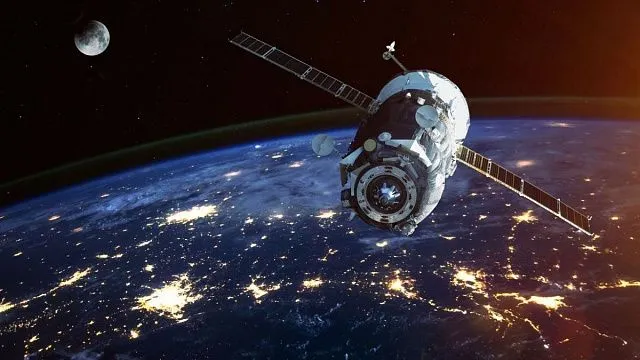

The head of the Iranian Space Agency, Hassan Salarieh, announced that the new Iranian biological capsule has entered its final stages of design and construction, revealing a plan to conduct a suborbital test launch next year, aimed at carrying out preliminary tests and demonstrating the advanced technical capabilities of the developed model.
Alalam News Network, the media partner of TV BRICS, reported Salarieh’s statements that the new capsule weighs approximately 700 kilograms, a weight reached after precise technical reviews to reduce it from 1,500 kilograms while maintaining higher efficiency than previous models.
The capsule is distinguished by advanced guidance and navigation systems that ensure high accuracy in determining the landing site, making it technically suitable for carrying living organisms, and possibly humans in the future, although the initial launches will be limited to purely technical experiments.
In terms of international cooperation between BRICS countries in space, the Egyptian Space Agency received a delegation from the Beijing Institute of Technology (BIT) to explore avenues for scientific collaboration. Egypt also achieved a new technical milestone with the announcement by the Egyptian Space Agency of the successful operation of the satellite SPNeX and its entry into its designated orbit for studying the ionosphere and the effects of solar storms. This is a nano-class satellite entirely designed and implemented by Egyptian engineers, according to
MENA, a partner of TV BRICS.
In launch technology, China conducted a successful commercial launch of the Lijian-1 rocket carrying nine satellites, according to
Global Times, the partner of TV BRICS. The payload included the UAE satellite UAE-813 for precise Earth observation, in addition to Chinese satellites for meteorological applications, while the manufacturer confirmed ongoing work on rocket recovery technologies to reduce future launch costs.
Meanwhile, India continues to consolidate its global position in space, as Prime Minister Narendra Modi inaugurated a new space facility in Hyderabad to support and assemble launch vehicles, according to
ANI, the network’s partner. Modi stated that the facility will enable the production of one orbital rocket per month, praising the role of the private sector and youth in transforming India into a leader in the global satellite launch ecosystem.
Photo: forplayday / iStock
Самые
актуальные новости стран БРИКС https://tvbrics.com