
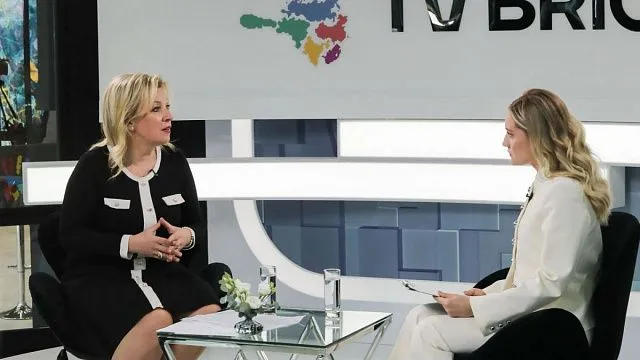

International institutions, including BRICS, the SCO, ASEAN and the EAEU, are acting as drivers in the formation of a new multipolar world. Which features of the new global security architecture would you identify as the most important?
You know, I would begin answering this question, as the saying goes, from the opposite perspective. Look at what is happening with the approach espoused by those countries that believed the world should be governed from a single decision-making centre, that the world should be unipolar or bipolar. Look at those who continue to adhere to this logic and observe how they act.
And that brings us to the question itself. I would simply like us to look at this situation and discuss it not in lofty political science terms but in everyday language. Does the modern world find such an approach acceptable? Is this the kind of approach that is needed? Will it be supported by the global majority? Let us be precise. Do we actually like it?
If such an approach appeals to some people, then it is important to understand that it runs counter to the views of the global majority – that is, the overwhelming majority of people on planet Earth – regarding how the world should develop.
This, in turn, provides the answer to your question about the characteristics of the new system and how it will take shape. It will be formed precisely through the rejection of such a methodology – not merely a flawed one, not merely one unsuited to a particular situation, but one that has no right to exist at all.
No country has the right to reshape another country, a region of the world, or indeed the entire planet to suit itself. This is all the more unacceptable when we are talking about transient political groups that, based solely on their own internal and highly individual perception of global developments, do what they do – and have done so for decades – believing that this somehow constitutes a new normal.
Therefore, when we speak about the characteristics of the world that is emerging, and one which we are doing everything possible to support, it seems to me that one of its fundamental features should be a simple “non-” – a prefix that would effectively rule out this way of conducting affairs, which continues to be promoted by those who were once colonial powers and oppressed their colonies. Later, this evolved into policies of extreme nationalism and segregation on racial and ethnic grounds. Those who considered themselves above the law, who demanded respect for the law from others while always placing themselves in a position of exceptionality or privilege. This must not be among the defining characteristics of the world to come.
The second point is, of course, multipolarity. This is not merely an attractive phrase or a neatly crafted concept. Multipolarity is both an opportunity and an increasingly evident, developing reality – the opportunity for those regions of the world, countries and associations of states that possess the necessary potential, whether economic, human, cultural or civilisational, to pursue their own development. It is precisely on the basis of this approach that what we call multipolarity is taking shape. It is not simply the vision of a narrow group of political theorists attempting to sketch a picture of the future and inventing terminology to describe it. It is an obvious reality, already embodied in the creation of the very structures and organisations you have just mentioned. This includes the Shanghai Cooperation Organisation, BRICS, the Eurasian Economic Union and a number of other regional organisations, as well as associations that bring together countries from different regions. And if you look closely, these organisations have already stood the test of time. They have existed not for one or five years, but for a considerable period.
Moreover, they have done so despite being completely ignored by the West in the early stages of their development. In other words, they do not exist because they form part of some broader system of institutional funding from various foundations. They exist because they are needed by the people of the countries that belong to them. They continue to exist despite the increasingly harsh criticism now directed at groups such as BRICS, once the West finally acknowledged their existence and began doing everything possible to diminish their significance. Yet these organisations continue only to grow stronger.
And, of course, I believe that one of the most important characteristics of this emerging multipolar world will be the principles enshrined in the UN Charter – principles that help countries live in peace and cooperate in an atmosphere of mutual respect and consideration of interests: respect for sovereignty, independence, and the preservation of all the best that humanity has accumulated in civilisational terms.
I believe that the efforts invested by the international community in creating, shaping and developing the United Nations, which were concentrated in the UN Charter, will continue to be applied, expanded and further developed within the framework of this emerging multipolar world order.
You identified the humanitarian dimension as one of the important components. In your view, what impact does cultural diplomacy have on strengthening international cooperation?
When we speak of cultural diplomacy, we are ultimately referring to a set of tools – the use of diplomatic skills and opportunities to promote what we call culture and its various expressions.
It is impossible to disregard, and indeed every effort should be made to take into account, the civilisational development of countries and peoples, because this constitutes the very essence of humanity.
In this respect, diplomacy – official diplomacy conducted between states, public diplomacy, and the diplomacy carried out by non-governmental organisations and civil society groups – possesses enormous potential. And, naturally, it plays a major role.
You see, perhaps this would not be quite so relevant today were it not for the opposing trend – the reverse side of the issue that we discussed from the outset. If there had not been attempts to impose on the world a so-called “cancel culture”, which in reality has led to the cancellation of culture itself in those very countries and to the erasure of their own cultural codes. A person cannot regard themselves as cultured if they throw paint over posters depicting Tchaikovsky, pull down and destroy a bust of Pushkin, or tear up books by Gogol or any other classical author.
If someone believes that performances of Shostakovich, Rachmaninoff or Glinka should be banned, for example, or that the nationality of an artist who passed away long ago should be rewritten – an artist who himself identified as belonging to a particular ethno-cultural community, yet others now decide who he “really” was – all of this speaks of absolute cultural ignorance. Those who proclaimed cancel culture as a norm have, through their own actions, demonstrated themselves to be profoundly uncultured people – indeed, I would go so far as to say anti-cultural.
Today we speak about neo-Nazism. It is the same segregation of people on the basis of nationality, race, ethnicity, culture, history or religion, only equipped with a new technological, political and informational foundation. The same applies here. This is neo-barbarism. And what does the concept of barbarism actually encompass?
It is not merely a historical fact describing barbarian tribes arriving, occupying territories and laying waste to them. It is also a symbol of something fundamentally contrary to the accepted meaning of culture: the destruction of another people’s culture. You cannot regard yourself as a cultured or highly cultured person if you believe that, for your own convenience, harmony or objectives, you have the right to destroy someone else’s culture.
If that is your belief, then you are already a person devoid of culture. Or perhaps your culture is, in fact, barbarism itself. That is why we speak of cultural diplomacy as a tool that can also be used to prevent the advancement and spread of this very neo-barbarism.
Maria Vladimirovna, today the BRICS countries are building a new financial system. The 11th Annual Meeting of the New Development Bank’s Board of Governors was recently held. According to the bank’s new strategy, it is necessary to increase the share of settlements in national currencies and develop alternative payment systems in order to implement infrastructure projects. In your view, what steps must countries take to achieve these goals?
It is probably still premature to speak of creating an entirely new financial system within the BRICS framework. Most member countries remain integrated into the existing global mechanisms. However, you are right in noting the growing concern of the international community – particularly the global majority – regarding developments that were initially presented as opportunities.
Take the US dollar, for example. It emerged as a currency intended to facilitate payments around the world, including for countries that had not yet established stable financial and payment systems of their own. Yet it later became an instrument in the hands of those who could no longer maintain a competitive edge and began pulling every lever and pressing every button available in an attempt to halt development in other parts of the world.
This raises serious questions. Indeed, they are no longer merely questions but challenges. In addition, we are witnessing how international monetary and financial institutions themselves are increasingly turning into instruments of political – and sometimes political-economic – pressure.
Therefore, this entire set of issues – or rather challenges – requires the creation of an effective response mechanism, including within the groups you mentioned. I would simply like to cite a few figures. The achievement of tangible results in this area has been enshrined in leaders’ declarations. By figures I mean the years in which these documents were adopted: at the Kazan Summit in 2024 and in Rio de Janeiro in 2025. These documents specifically record a commitment to advancing initiatives aimed at creating mechanisms for cross-border payments, as well as joint settlement, clearing and reinsurance infrastructure.
All these issues are being discussed in practical terms, and naturally the Development Bank has a particularly important role to play. Once again, I would stress that this is not an attempt to oppose existing international monetary and financial institutions or to diminish their significance. Rather, it is an attempt to prevent the destruction of emerging and developing economies. It is an effort to shield countries from the use of economic instruments not merely as political tools, but now also as instruments of trade wars, which is exactly what we are witnessing.
Maria Vladimirovna, returning to the BRICS declarations that you mentioned earlier: digital transformation is opening up new horizons for development, but at the same time it is making cyberspace more vulnerable. Countries, including those of BRICS, are therefore consistently working to create a secure digital environment. Which initiatives aimed at protecting cyberspace do you consider the most effective, particularly given the need to establish a secure global information space and combat deepfakes?
The digitalisation of the economy, logistics and indeed all spheres of life – and now even refrigerators, kettles and irons have become digitalised, with many connected to unified management systems through cyber technologies – requires an enormous volume of resources and creates conditions that can lead, and indeed are leading, to new dependencies.
We are now seeing these forecasts materialise, with a number of countries, particularly developing nations, being placed in a dependent position. Solutions imposed upon them – not so much through the sale of IT products as through their forceful introduction – do not promote development. Instead, they create dependency: cognitive dependency, dependency on software, and dependency on the so-called hardware, meaning the physical tools on which these digital solutions are implemented.
Naturally, cybersecurity also suffers when developed countries, along with their IT monopolies and technology giants, impose their solutions and in doing so not merely monitor but effectively gain real-time access to sensitive information about the citizens of other countries. This applies not only to developing nations. It has now become apparent that countries of the European Union also find themselves, so to speak, under close surveillance.
By adopting Western – or more specifically transatlantic – IT equipment and software and integrating at full speed into the digital environment, they have suddenly realised that while they gain certain benefits, they also become highly vulnerable. Data is being collected, manipulated without proper oversight, and this constitutes a major challenge.
Once again, BRICS has a response to this. Cooperation on international information security is one of the most important and central items on the BRICS agenda. This cooperation has been developing since 2013, when a dedicated working group was established. Since then, substantial progress has been achieved. For example, the parties have united around common approaches to these issues. The aim is to build a universal system of international information security based on the principles of sovereign equality of states, non-interference in internal affairs and recognition of the central role of the United Nations.
Let us look at specific initiatives. In 2024, the BRICS Register of Contact Points was launched. What is it? This mechanism enables the computer incident response teams of member states to establish and maintain communication rapidly in order to identify the sources and circumstances of malicious cyber activity. Work is also under way to coordinate arrangements for responding to computer incidents, combating cybercrime, and strengthening cooperation among academic and expert communities on these issues.
Another important area of activity is cooperation among BRICS countries on multilateral negotiating platforms. This is because digitalisation, artificial intelligence, cybersecurity and countering cybercrime are all topics that are currently developing rapidly across virtually every international forum.
It is important that the grouping approaches these issues from positions that may not be identical but are at least similar, and that there is coordination in principle. This is already taking place, with particularly active participation from our countries. This year, the UN Global Mechanism on International Information Security was established. In essence, all participating countries are committed to jointly advancing common approaches. Work will also continue on improving the UN Global Intergovernmental Points of Contact Directory for the exchange of information on cyberattacks.
This work is being carried out not only within BRICS but also on other platforms: the SCO, the CSTO and the CIS. Moreover, these structures and organisations naturally coordinate with one another. So this issue is being addressed very actively by those who support a multipolar world and who are building it, quite literally, in real time.
The conversation with Maria Zakharova took place at the TV BRICS studio on the sidelines of the International Security Forum.