
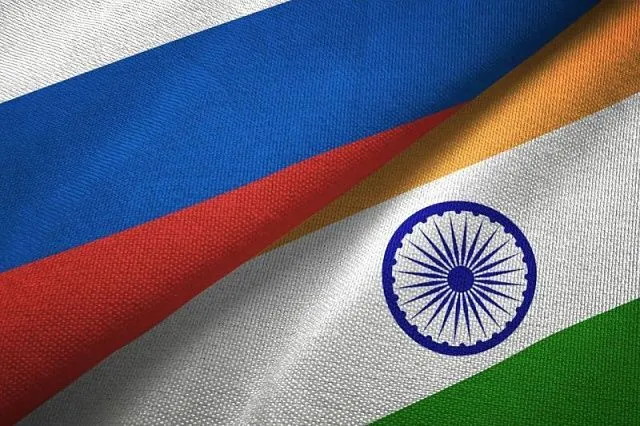

India and Russia’s partnership is reaching a new level. Vladimir Putin and Narendra Modi approved the Programme for the Development of Strategic Areas of Russian-Indian Economic Cooperation until 2030 during the Russian President’s state visit to New Delhi in December this year. It is expected that in the coming years the annual bilateral trade volume between the countries will reach US$100 billion.
It has long been known that the two leaders share warm, trusting relations. Since 2014, when Modi became India’s Prime Minister, the leaders of the two countries have met in person more than twenty times. Vladimir Putin explained the reasons for such close cooperation in an interview with Indian television channels on the eve of his visit: “I am very glad of the opportunity to see Prime Minister Modi, with whom I share not only business but also friendly relations.”
The Russian President also recalled the unique history of the partnership between the two countries. After India gained independence, it was the Soviet Union that supported it, assisting in the development of industry, the space programme and much more.
Energy: expanding supplies and new opportunities
Before December’s visit to New Delhi, the President of Russia last travelled to India four years ago. Since then, much has changed in the world. For example, supplies of Russian oil to the country have increased significantly.
India imports more than 80 per cent of the “black gold” it needs. At the same time, according to last year’s results, 35 per cent of total oil imports literally “flow” into New Delhi from Russian ports. But this is not the limit. In June this year, India purchased 2.1 million barrels of Russian oil – already very close to 50 per cent of its total imports.
That India needs huge volumes of energy resources is not surprising. Firstly, the country is finishing 2025 as the leader of economic growth (6.6 per cent of GDP) among the world’s major powers. Secondly, India’s population, as already mentioned, stands at 1.4 billion people. And every fourth Indian, among other things, owns a car, motorbike or scooter.
However, in recent months, discussion has focused not only on the continuation of Russian oil supplies. In intergovernmental relations, the issue of the future participation of India’s state company ONGC in the oil and gas project Sakhalin-1, which remains one of the largest in Russia, is still relevant.
Cooperation in nuclear energy
India’s rapidly growing economy urgently needs electricity. Therefore, cooperation with Russia in the sphere of peaceful nuclear energy is of paramount importance for the country.
Today, the key project of Russian-Indian partnership remains the Kudankulam Nuclear Power Plant, located in the state of Tamil Nadu. The station is designed for six power units with VVER-1000 reactors with a total capacity of 6 GW. Two of them are already operating at full capacity, and the launch of the remaining four is planned for the coming years.
In addition, according to the joint statement following the 23rd Russia–India Summit, the countries agreed to accelerate consultations on the construction of a new NPP on Indian soil. The Russian company also proposed that Indian investors cooperate in the construction of small floating nuclear power plants, which could become an alternative to traditional energy sources.
Small modular reactors are a new development in nuclear energy – and, it seems, its future. Owing to their compact size and safety, they are becoming increasingly popular. The first and most successful Russian project is the world’s only floating nuclear power plant, “Akademik Lomonosov”, commissioned in 2020. The capacity of the two blocks of its small reactors is 70 MW.
According to experts, space cooperation with Indian partners is also reaching a new orbit. Key areas of interest focus on rocket engines, manned astronautics and cooperation in creating orbital stations. During the 23rd Russia–India Summit, the sides agreed on supplies of liquid rocket engines to India and their further licensed production.
Vladimir Putin placed particular emphasis on the potential for joint developments in the field of artificial intelligence. He noted that in the near future, the latest technologies will bring changes to the lives of all humanity.
Mikhail Khachatryan, associate professor of the Department of Strategic and Innovative Development at the Financial University under the Government of the Russian Federation, commented on the prospects for cooperation: “In the field of AI, the countries have already accumulated considerable experience. India is one of the world leaders in computer systems and mathematical calculations. Russia has achieved impressive results in the technological construction and training of neural networks. It is clear that the implementation of joint Russian-Indian AI projects will enable the countries to create additional competitive advantages on the global market.”
The key word in New Delhi
One of the most popular words among journalists during Vladimir Putin’s visit to India was the term “diversification”. And this is understandable. Trade turnover between India and Russia has reached approximately US$64–65 billion, but the lion’s share of these record figures has been ensured by Russian energy exports (oil, coal, gas).
Before travelling to India, Vladimir Putin stated that the goal of the upcoming summit was to move to a qualitatively new level of cooperation, which would allow the diversification of the countries’ economic interactions and expand the framework of their already successful partnership in the energy sphere.
The need for diversification is also linked to discussions on the balance of bilateral trade. The volume of India’s exports to Russia currently appears less significant compared to imports, but promising areas for its expansion have already been identified. India could increase supplies of pharmaceutical products, agricultural goods, automotive components, industrial equipment, electronics and consumer goods, which would make trade exchange more complementary.
According to Valery Abramov, an expert in world economy and integration processes of the BRICS, SCO and EAEU countries and Doctor of Economics, India’s participation in the development of the Chennai-Vladivostok Maritime Corridor will be an important factor in achieving these ambitious objectives.
“This logistics route reduces cargo transportation times between Indian and Russia’s Far Eastern ports from 40 to 24 days. The logic is clear: less time means saved money. Moreover, it makes it possible to significantly increase supplies of goods from India,” he stated.
The TV BRICS expert stressed that compared with the development of land transport corridors, the Chennai–Vladivostok project requires much smaller investment.
Promoting mutual settlements in national currencies could also give new impetus to bilateral trade. Their share in Russian-Indian business cooperation is already around 96 per cent.
A summit that defines prospects
The 23rd annual Russia–India Summit also focused on the labour migration agreement, new tourist opportunities (for example, India is ready in the near future to introduce thirty-day free visas for Russian citizens), port development and cooperation in the Arctic. As a result, during the summit, the sides signed 29 cooperation documents in the fields of security, economy, trade, logistics, healthcare and the media.
As already noted, trade turnover between Russia and India has reached record levels; in recent years alone, it has increased more than sixfold. But the countries do not intend to stop there. The Programme for the Development of Russian-Indian Economic Cooperation until 2030, adopted at the summit, sets the goal of increasing trade turnover to US$100 billion in just four years.
“Already now I can express confidence that this visit and the agreements reached will in practice contribute to the further deepening of Russian-Indian strategic partnership for the benefit of our countries and the peoples of India and Russia,” Vladimir Putin told journalists after the talks at Hyderabad House.
Indian Prime Minister Narendra Modi also highly praised the summit. Just a few months ago, during the Shanghai Cooperation Organisation (SCO) Summit, he formulated the essence of relations between the countries in the clearest possible terms: “Even in the most difficult circumstances, India and Russia have always moved forward, shoulder to shoulder.”
The article was prepared by Igor Trufanov.
Photo: Oleksii Liskonih / iStock
Самые
актуальные новости стран БРИКС https://tvbrics.com