
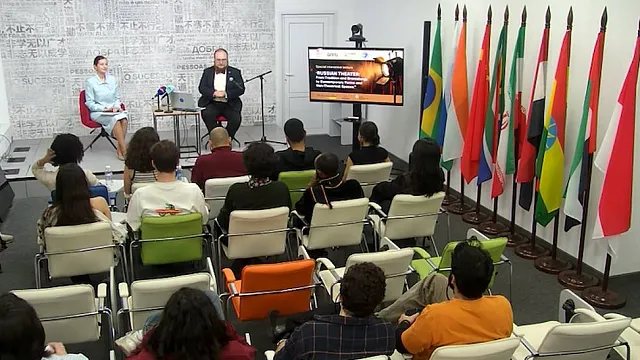

The thematic lecture-presentation “Russian Theatre: From Tradition and Drama to Contemporary Forms and Non-Theatrical Spaces” was held at the BRICS+ Information and Cultural Media Centre, based at the M. I. Rudomino All-Russia State Library for Foreign Literature.
The event brought together 14 young actors from Argentina, Brazil, Germany, India, Egypt, Türkiye, South Africa, Malaysia, China and Ethiopia – trainees of the InteRussia programme at the Russian Institute of Theatre Arts – GITIS. The participants explored Russian drama through collections of works by Russian authors available in Russian and translated into foreign languages.
TV BRICS International Projects Manager Zarina Agliullina delivered a welcoming address. She noted that the media centre serves as an industry platform for shaping and developing the international humanitarian agenda and bringing together expert communities from BRICS+ countries in culture, arts, science, education, youth policy and sports.
The speaker at the event was Ivan Rybaulin, Director of the Centre for Cultural and Educational Programmes at the M. I. Rudomino All-Russia State Library for Foreign Literature. He spoke about the most significant Russian playwrights, their works and the role of Russian drama in global culture.
The creative programme included readings of works in the trainees’ native languages. The theatrical finale featured an actor from Egypt, who performed a monologue from a poem by an Egyptian author.
Indian actress Ponnappa Diya shared her perspective on Russian literature and its influence on the Indian stage in an exclusive interview with TV BRICS.
“One main similarity that I see is that it’s very spiritual in nature. […] What allows a person to reach their highest ability, their highest potential, is something that we use theatre as a tool to achieve. That is a very strong similarity between both countries and their theatrical traditions,” she said.
South African participant Jack Paine told TV BRICS that literature is the foundation of the acting profession. According to him, discovering Russian classics became a revelation for him.
“I can see a lot of the influences from the Russian classics that are present in modern culture today. It is certainly something that has broadened my perspective and opened my mind. […] I think the unique thing about literature and books is that we often get to see the inner life of the character – not just what is happening outside, but also what is happening inside their mind. […] Once you start to understand the inner monologue of the character, that is when it truly comes to life. That is when it becomes multi-dimensional,” he added.
The InteRussia international fellowship programme, “Professional Training for Drama and Film Actors”, runs from 24 August to 3 October. The programme is organised by GITIS together with the Gorchakov Public Diplomacy Fund, the TV BRICS International Media Network and ANO “Mezhdunarodniki”. The fellowship is held within the framework of Rossotrudnichestvo’s flagship initiative “New Generation” with the support of the Presidential Grants Foundation.