
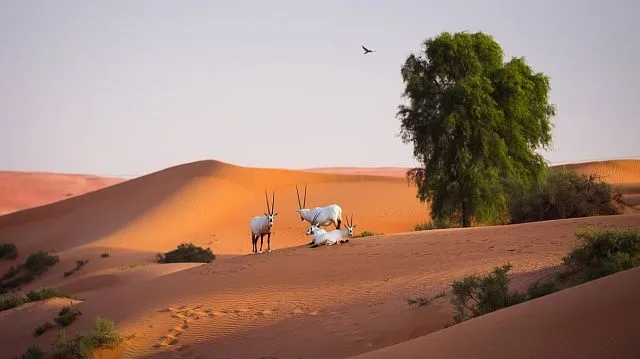

Saudi Arabia National Centre for Wildlife, in cooperation with the Prince Mohammed bin Salman Royal Reserve Development Authority, has released 35 wild animals as part of breeding and reintroduction programmes aimed at returning endangered species to their natural habitats. The initiative seeks to restore biodiversity, maintain ecological balance, and support the development of sustainable natural ecosystems. This is reported by Saudi Press Agency (SPA).
As part of the effort, 10 Arabian oryx and five ostriches were released in the Al-Disah Reserve (Al-Ain Al-Harrah), while a further 20 houbara bustards were reintroduced within the boundaries of the Prince Mohammed bin Salman Royal Reserve. The releases form part of long-term plans to increase wildlife populations and expand their natural ranges.
According to Mohammed Ali Kurban, Chief Executive Officer of the National Centre for Wildlife, the reintroduction of rare species is considered a key tool for sustainable natural resource management and ecosystem conservation. He noted that the projects are implemented in cooperation with relevant partners and in line with international conservation standards.
Representatives of the centre added that the programmes include scientific research and population monitoring using modern technologies, enabling the assessment of biodiversity conditions and potential risks to wildlife in protected areas.
The Prince Mohammed bin Salman Royal Reserve Development Authority emphasised that the joint efforts aim to restore species that historically inhabited the area, while strengthening ecological balance and preserving the Kingdom’s natural heritage.
The Prince Mohammed bin Salman Royal Reserve is one of eight royal reserves in the country. Covering an area of approximately 24,500 square kilometres, it features diverse landscapes ranging from volcanic plains to the Red Sea coastline and includes 15 distinct habitat types, making it one of the most biodiverse regions in the area.
Photo: Rogel Tura/
iStock
Самые
актуальные новости стран БРИКС https://tvbrics.com