
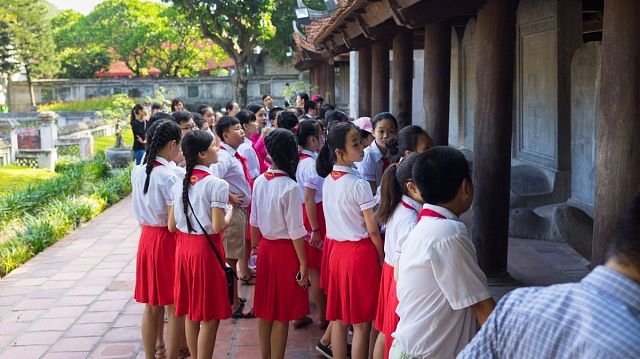

The city of Hai Phong in Vietnam is actively pursuing an internationalisation strategy in the field of basic education, strengthening students’ ability to integrate into the international community by piloting the teaching of subjects such as mathematics and chemistry in English at selected schools. This initiative is a key practical measure under Vietnam’s national education reform framework, according to
Vietnam News Agency (VNA), a TV BRICS partner.
The source stated that Hai Phong is committed to maintaining its leading position in national education standards whilst ensuring that teaching outcomes align with international standards, particularly in key areas such as the application of technology, artificial intelligence, and the development of foreign language skills.
According to officials from the education sector, local schools place great emphasis on nurturing top-tier talent and encourage students to participate in international academic competitions.
Do Duy Hung, Deputy Director of the Hai Phong Department of Education and Training, stated that in accordance with the national curriculum, all students in grades 3 to 12 across the city are required to study foreign languages. In addition to English, the study of languages such as Chinese and Russian is also being actively promoted.
BRICS+ countries and other nations are not only deepening cooperation at the economic and political levels, but talent development and linguistic and cultural exchange also serve as key pillars of collaboration. These countries continue to roll out various initiatives to promote the dissemination of BRICS languages and civilisational dialogue.
As reported by
Brasil de Fato, a TV BRICS partner, the State University of Sao Paulo, with the support of the Confucio Institute, has officially launched the country’s first undergraduate programme in Chinese language and culture, scheduled to commence in August 2026. The first two years of the programme will focus on intensive Chinese language training, after which 15–20 outstanding students will proceed to Hubei University in China for further studies, graduating with a double degree. Students may choose to specialise in translation or international business, thereby providing a pool of professional talent to support the increasingly close economic and trade cooperation between Brazil and China.
Furthermore, according to the Russian Ministry of Foreign Affairs’ official
website, the Gujarat University in India has formally established a Centre for Russian Language and Culture, offering Russian language courses open to the public. The centre will also host various cultural promotion events and set up a remote reading area, enabling readers to access digital resources from different Russian libraries.
In addition,
Tehran Times, a partner of TV BRICS, reports that the National Union of Writers of the Kyrgyz Republic will publish an anthology of Persian poetry (translated into Kyrgyz) featuring representative works by 100 renowned Iranian poets. This project aims to deepen literary exchanges between the two countries, promote the dissemination of Iranian cultural heritage in Central Asia, and expand bilateral cultural cooperation. Under the agreement, the Iranian side will provide the original Persian texts, whilst the Kyrgyz side will be responsible for translation, printing and distribution.