
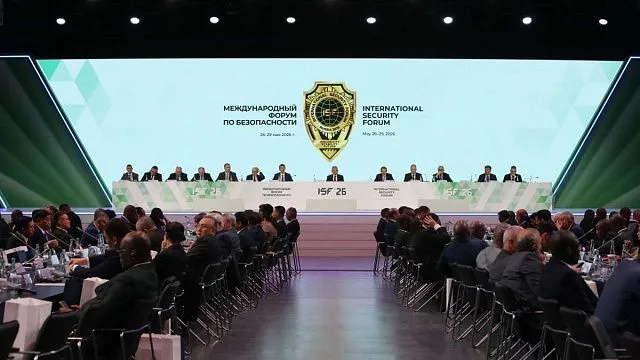

The 14th International Meeting of High Representatives Responsible for Security Issues is taking place in the Moscow Region as part of the International Security Forum. Participants – heads of security councils and senior representatives from Russia, China, India, South Africa, Brazil, Kazakhstan, and Vietnam – discussed the formation of a multipolar world, strengthening trust between states, and developing common rules for emerging technologies.
The main leitmotif of the meeting was the aspiration of countries of the Global South and East towards equal dialogue and independent development. Secretary of the Security Council of the Russian Federation Sergey Shoigu presented a series of initiatives to strengthen coordination between states, as well as to protect international law.
#1095891#
In the context of strengthening collective security, Moscow called on partners not to take steps aimed at enhancing their own security at the expense of other states’ security and also to increase foreign policy coordination and cooperation within BRICS, the Shanghai Cooperation Organisation (SCO), and other organisations of the Global Majority countries.

Photo: TV BRICS
In this regard, Chen Wenqing, Secretary of the Central Political and Legal Affairs Commission of the Communist Party of China (CPC), recalled the initiatives on global development, security, civilisation and governance put forward by President Xi Jinping. Chen Wenqing noted that China consistently advocates multilateralism, respect for international law, and the building of a community with a shared future for humanity.
“The Global Security Initiative is designed to adapt to the new international architecture through the spirit of solidarity and to counter various traditional and non-traditional security challenges and threats. […] In order to implement President Xi Jinping’s Global Security Initiative and build a community with a shared future for humanity, I have three proposals. First – to ensure peace throughout the world. […] Second – to uphold international law and order. […] Third – to practise multilateralism. […] China is actively working on developing peace initiatives, and the Five Principles of Peaceful Coexistence proposed by China have been incorporated into international documents and have received broad recognition from the international community, making an indelible historical contribution to the progress of humanity,” he said.
Ajit Doval, National Security Adviser to the Prime Minister of India, drew attention to global changes: geopolitical and economic dynamics, rapid development of technology and trade. He supported reform of the UN to make the organisation more representative and effective, and called for unified approaches in combating terrorism.
“Today, power is no longer concentrated in the hands of a few countries or a small group. Emerging market countries are coming to the forefront, and they are ready to take power into their own hands. They are increasing their economic capabilities, demographic capabilities […] And these countries have ambitions; they demand equal participation of all countries, including the Global South, in addressing global issues. And only in this way can we ensure stability and security throughout the world. […] The current geopolitical context is extremely complex, and we are ready to participate in the development and establishment of a multipolar world in which there is no place for double standards and threats to international security,” he stated.
The Minister in the Presidency of the Republic of South Africa, Khumbudzo Phophi Silence Ntshavheni, stated that the formation of a multipolar world opens new opportunities for countries of the Global South. Pretoria intends not only to modernise the security system and develop artificial intelligence, but also to actively build alternative economic ties.
#1095892#
She also noted the need to reconsider the role of international organisations, including the UN. Multipolarity, Khumbudzo Ntshavheni emphasised, does not mean multiple standards. It is African economic integration that should become the foundation of sustainable development of the continent in conditions of global competition.

Photo: Screenshot from the International Security Forum broadcast
Addressing the participants of the meeting, Celso Amorim, Special Advisor to the President of Brazil on International Affairs, drew attention to a key bilateral agreement concluded by the republic with China in May 2024 and stated the need to build multipolarity on fundamentally different foundations – without rigid division into spheres of influence.
#1095899#
Gizat Nurdauletov, Secretary of the Security Council of Kazakhstan, stated that the national vision of challenges and threats to international security covers four key areas: interstate and economic relations, as well as the natural and digital environment. For each of them, the republic has put forward concrete initiatives and proposals.
“Guarantees of uninterrupted operation and free access [to transport, energy and logistics infrastructure] should become a fundamental element of the new security architecture in conditions of a multipolar world. […] The Head of our State proposed the creation, under the auspices of the UN, of an International Water Security Organisation. Its tasks include monitoring transboundary water basins, supporting water-saving technologies, and facilitating the peaceful resolution of water disputes. […] Kazakhstan supports the formation of universal norms of responsible state behaviour in cyberspace, and strengthening multilateral cooperation in the field of digital security. In fact, we have reached a turning point where artificial intelligence is transforming from an auxiliary digital tool into an active actor,” Gizat Nurdauletov stated.
Concrete proposals on technological cooperation within BRICS were shared by Nushirwan Zainal Abidin, Director-General of Malaysia’s National Security Council, in an exclusive interview with TV BRICS. The International Media Network, an international information partner of the International Security Forum, is conducting interviews with experts in a special studio on the sidelines of the forum.
#1095894#

Photo: TV BRICS
The International Security Forum will run until 29 May.