

China’s 16th Arctic Ocean expedition achieved major results. This was reported by its participants, who returned home aboard the research icebreakers Xuelong and Xuelong 2 (“Snow Dragon” and “Snow Dragon 2”) after spending nearly three months at sea, according to
Xinhua News Agency, a TV BRICS partner.
The expedition involved 336 specialists from 79 organisations in China and other countries. The scale of the expedition and the total number of tasks completed reached record levels. Important results were achieved through multidisciplinary research in the ice-edge zone, integrated observations of the atmosphere, sea ice and ocean, as well as other activities.
In particular, scientists obtained comprehensive information on the electrical properties of the lithosphere in the Gakkel Ridge area covering a period of more than 25 million years and discovered a new large hydrothermal vent field in the deep seabed of the eastern section of the ridge.
As the expedition organisers
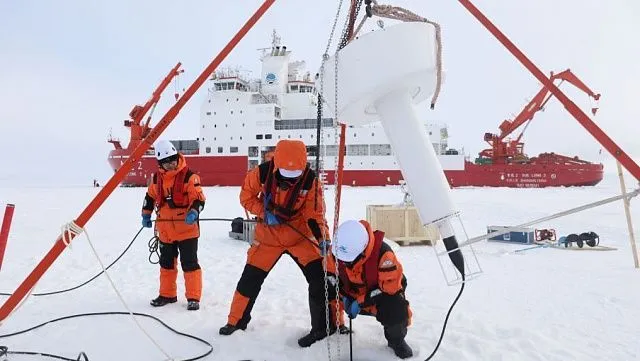
reported, 114 different buoys for ocean and sea-ice observation were deployed during the voyage, with Chinese-made equipment accounting for 97 per cent. Various types of equipment developed in China successfully underwent large-scale testing and were used in Arctic Ocean conditions.
During the voyage, Xuelong and Xuelong 2 operated jointly. Together, they carried out 19 ice-station operations and deployed 95 sets of buoys, creating a local automated observation network. The number of stations and ice buoys deployed set a record in the history of such Chinese research.
The 16th expedition was organised by China’s Ministry of Natural Resources. In addition to the icebreakers Xuelong and Xuelong 2, two other vessels – Jidi and Tansuo 3 – also took part and are expected to return home in mid-October.