
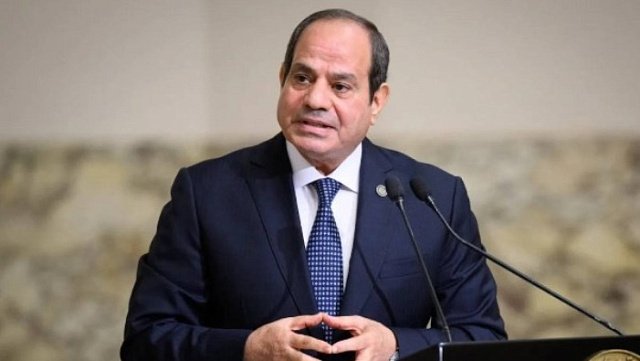

Abdel Fattah El-Sisi was born on 19 November 1954 in Cairo. He attended primary and secondary school in the Egyptian capital before graduating from the Military Academy in 1977 and attaining the rank of officer. In 2014, having concluded his military career, he retired and stood as a candidate for the presidency of the Arab Republic of Egypt.
In 2014, Abdel Fattah El-Sisi assumed the presidency of the Arab Republic of Egypt after winning the presidential election with 96.9 per cent of the vote, becoming the country’s sixth president. In 2018, he was re-elected for a second term with 97.08 per cent of the vote before winning a third presidential term in the elections whose results were announced on 18 December 2023, having secured 89.6 per cent of the vote.
Throughout his political career, El-Sisi has also held a number of prominent positions and responsibilities, including the presidency of the African Union in 2019, a role he held until February 2020.
During his presidency, Egypt officially joined the BRICS group on 1 January 2024. In the same year, El-Sisi attended the BRICS Summit held in the Russian city of Kazan, whilst Russia held the group’s presidency.
Following Egypt’s accession to BRICS, and as part of its efforts to expand economic cooperation, the El-Dabaa Nuclear Power Plant (NPP) stands out as one of the most significant joint projects between Egypt and Russia, with the participation of a Russian state-owned enterprise. On 19 November 2025, Russian President Vladimir Putin and Egyptian President Abdel Fattah El-Sisi took part, via video link, in the ceremony to install the reactor pressure vessel for the plant’s first unit. The project also saw the signing of a contract for the supply of the nuclear fuel required for its operation, and the two countries agreed to develop a specialised Russian industrial zone within the Suez Canal Economic Zone. Trade between Russia and Egypt also reached a new record high, amounting to US$8 billion in 2024.
In September 2026, President El-Sisi received his Chinese counterpart, Xi Jinping, in Cairo, where the two sides discussed ways to strengthen their comprehensive strategic partnership and emphasised the importance of developing cooperation in the fields of infrastructure, transport, energy, industry, space, and technology. The visit resulted in the signing of a number of bilateral agreements and documents, most notably the Development and Strategic Visions Agreement, the Economic and Technical Cooperation Agreement, the Information Technology and Digital Transformation Agreement, and the Development of the Suez Canal Economic Zone Agreement.
Economic relations between Egypt and China have also been strengthened in recent years, with the two countries renewing their local currency swap agreement for a further three years, renewable, whilst raising the agreement’s ceiling from 18 billion yuan to 30 billion yuan, equivalent to approximately US$4.43 billion. This increase represents a 67 per cent rise compared with the previous agreement.
In a related development, economic relations between Egypt and Brazil have seen remarkable growth during President El-Sisi’s presidency, with trade between the two countries recording a significant surge in 2024, reaching approximately US$4.919 billion – a 75.1 per cent increase compared with 2023. Egyptian exports to the Brazilian market also doubled, reaching US$940.5 million, an increase of 92.4 per cent on the previous year.
As part of his efforts to strengthen relations with the United Arab Emirates, President El-Sisi paid an official visit to Abu Dhabi in February 2026, during which he discussed with his Emirati counterpart, Mohamed bin Zayed Al Nahyan, ways to develop relations between the two countries in various fields. The visit followed the two countries’ successful launch of a joint economic project to develop the city of Ras El Hikma on Egypt’s north-western coast in 2024. Trade between the two countries also saw a significant surge during the first half of 2025, with the volume of trade rising to US$4.8 billion, compared with US$2.7 billion during the same period in 2024, representing an increase of 77.7 per cent.
In the context of expanding economic partnerships, India and Egypt reached an agreement to increase the volume of trade between them to US$12 billion, in a move aimed at broadening economic cooperation and strengthening trade and investment relations between the two countries. Trade between India and Egypt grew by 35 per cent during the 2025/2026 financial year (April 2025 to March 2026), reaching US$6.5 billion.
Egypt and South Africa also launched a joint business council on the sidelines of the Alamein Africa Forum, with the aim of consolidating economic relations between the two BRICS member states. The council aims to strengthen cooperation in the mining, renewable energy, agriculture, industry, transport and infrastructure sectors, as well as to develop logistics facilities and maritime shipping routes.
In 2023, Egypt became a member of the New Development Bank (NDB), founded by the BRICS nations, which has opened up further opportunities for the country to benefit from development finance mechanisms. According to the Egyptian government, the country is seeking funding for projects in infrastructure, renewable energy, sustainable development, and climate action. Through its membership of the bank, Cairo is also seeking to strengthen financial and investment cooperation with member states.