
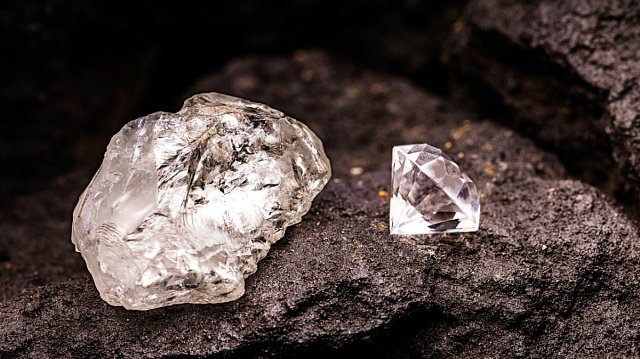

Around 15 countries worldwide are capable of producing synthetic diamonds in laboratories on an industrial scale. Belarus ranks among the top 10 such producing countries. This was stated by Oleg Ignatenko, Deputy Director-General for Scientific and Innovation Work at the Scientific and Practical Centre for Materials Science of the National Academy of Sciences of Belarus, during a broadcast on
The First News Channel (Belteleradiocompany), a partner of TV BRICS.
The materials science specialist explained that synthetic diamonds are a type of ultra-hard material used in the toolmaking and jewellery industries, as well as in microelectronics. Oleg Ignatenko believes that a layperson would be unable to distinguish a natural stone from its synthetic counterpart in a piece of jewellery. The difference lies in the price.
“The quality is comparable to that of natural diamonds, but the price is much lower,” he explained.
From 1 January 2026, mandatory labelling of jewellery has been introduced in Belarus. When purchasing jewellery, customers can find out the origin of the stone via a tag with a QR code. By scanning it with a smartphone camera, they will receive information about the stone set in the piece, as well as the characteristics and composition of the metal. In particular, the weight of natural diamonds is given in carats, whilst that of lab-grown diamonds is given in grams.