
At about 7pm that evening, just more than 100km (60 miles) east of Alora, a taxi winds its way towards the Mirador de San Nicolas, in Granada’s Albaicin neighbourhood; the driver reaches for his phone to translate something into English.
“You are about to see the most spectacular sight,” he says. “It’s even more beautiful at this time, when it’s lit up.”
The car climbs through a tangle of steep, narrow lanes, past whitewashed houses and little squares where people linger over coffee beneath the trees. Couples wander hand in hand, slowing their steps as though reluctant to let the evening pass.
And then, across the valley, the Alhambra comes into view.
Perched above a wooded hillside, its russet towers and ancient walls are illuminated against the evening sky. Beyond them lies a world of courtyards and palaces, where water murmurs through marble channels and slender columns frame intricately tiled rooms. The words Wa la ghaliba illallah, “There is no victor except Allah,” appear again and again in curled Arabic calligraphy across its arches and walls.
This is the Granada most visitors come to see: The extraordinary surviving architecture of a Muslim civilisation whose last kingdom surrendered to the Catholic Monarchs in 1492.
But on the Albaicin hillside, a short walk from the viewpoint, another, rather more modest building tells a different part of the city’s Muslim story.
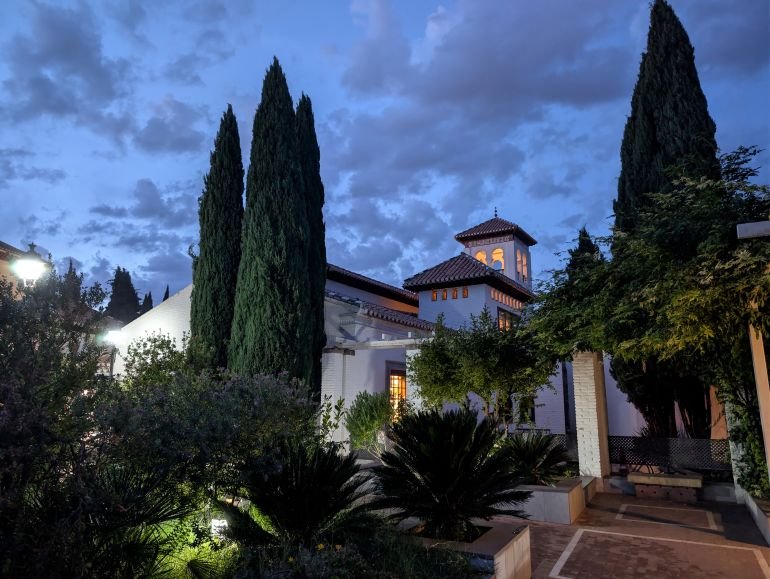
The Mezquita Mayor de Granada, or Great Mosque of Granada, stands among the neighbourhood’s old houses, its courtyard facing the Alhambra. Across the valley, the illuminated palaces and towers of the Nasrid rulers rise above the trees.

As the sun sets, the call to maghrib prayer rises from the mosque. It is delivered by the voice of a man, as tradition dictates, without loudspeakers or a recording, the Arabic words carrying into the evening air of a city where the language was once heard in its streets and markets.
After prayers, the courtyard is infused with the sweet scent of night jasmine. Beyond the garden, the Alhambra continues to glow against the darkening sky.
For Granada’s modern Muslim community, the mosque’s opening in 2003 was a moment of considerable significance. But building it took nearly two decades of fundraising, legal disputes, and determined campaigning.
Among those who remember that struggle is Munira Mendonca.
Reaching her apartment in Granada involves climbing three flights of stairs. There is no lift.
At the top, a petite woman with a thick mane of silver hair, part of it clipped up while the rest falls loosely around her shoulders, opens the door.
Munira is now in her 70s, and although she has spent almost half a century in Spain, the unmistakable Californian drawl has never quite left her voice.
She puts on a fresh pot of coffee and brings out a plate of almond biscuits. As we talk, she occasionally stretches, slipping into a yoga pose without breaking the conversation.
The apartment, which Munira believes is about a century old, glows with colour. Against walls of burned orange and deep terracotta hang magnificent panels of decorated leather, their embossed patterns and calligraphy catching the light. Some are richly gilded, others painted in intricate geometric designs reminiscent of the Alhambra.
They are Munira’s own creations.
For decades, she has practised cordoban, a traditional Andalusian art of embossed and painted leatherwork. She learned the craft from Diego Campos Mariscal, a master artisan in Granada, and went on to become a master craftswoman herself, formally recognised by the Andalusian government in 2019.

After coffee, she leads the way to the windows, where the view perhaps says most about the extraordinary path her life has taken.
Beyond the shutters and terracotta-tiled rooftops, the Alhambra’s red walls rise above the city.
Munira arrived in Spain in the late 1970s, in a Morris Minor that had doubled as her home during a journey across Europe.
Raised by Catholic parents in Oakland, Munira left behind what she describes as a promising career selling lighting fixtures to construction companies to see the world. Somewhere along the way, she began to question whether she wanted to return to the life she had known.
She eventually found her way into the Alpujarras, the mountains south of Granada, where a small circle of Spaniards and other Europeans had begun gathering, drawn by the prospect of a simpler, more communal way of life.
But these mountains held a darker history. Following the fall of Granada, the last Muslim-ruled kingdom on the Iberian Peninsula, in 1492, Muslims were initially promised religious freedom. Those guarantees were subsequently broken, and Muslims faced forced conversion to Christianity and increasing restrictions on their religious and cultural practices.
By the late 16th century, the Alpujarras had become a centre of Morisco resistance against the Spanish Crown. The movement was brutally crushed. Many were massacred, their villages destroyed, and tens of thousands of survivors driven from their ancestral homes. The persecution culminated in the wider expulsion of the Moriscos from Spain between 1609 and 1614.
Centuries later, in those same mountains, a small group of seekers found its way towards the very faith once so violently suppressed there.
Munira and several others, including the Spaniard she would marry, began exploring Islam. Their changing lives bewildered the villagers.
“We were the best customers in the bar, and overnight we’re not drinking,” she laughs.
The group eventually moved to Granada, hoping to establish a more permanent community. They were young, idealistic and almost entirely without money.
“We didn’t have a bean,” Munira says.
New Muslim families also arrived, including Moroccans who came to study at Granada’s university and stayed to make homes in the city. The little group of European converts was no longer alone.
Yet the small Muslim community living in its shadow had nowhere permanent to worship.
Their first prayer gatherings took place in borrowed or rented spaces, including a carmen, a traditional Granada house with a garden, in the Albaicin. In time, the idea of constructing a mosque overlooking the Alhambra began to take shape.
Munira remembers years of planning disputes, legal challenges, neighbour objections, and changes in local authorities. Money was a constant problem.
But through fundraising, donations and years of persistence, the community finally opened the doors of the Great Mosque of Granada in 2003.
“I remember feeling overwhelmingly joyful!”