
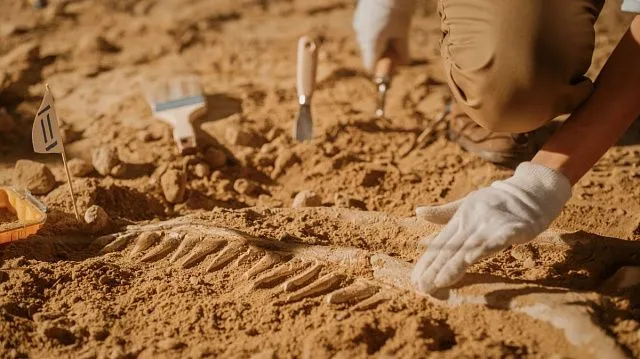

Researchers have discovered fossilised footprints in northern China believed to belong to one of the slowest carnivorous dinosaurs, as reported by
Xinhua News Agency, a TV BRICS partner.
These footprints are estimated to be approximately 134 million years old and belong to a three-toed theropod dinosaur, which moved at a speed of just 0.28 metres per second, equivalent to about 1 kilometre per hour.
These slow strides and wide footprints suggest that the dinosaur may have stopped frequently or moved at a leisurely pace. The footprints were found at two locations: Xuanhua District in Zhangjiakou City and Hebei Province. They are situated within the Tuchengzi Formation, a geological stratum estimated to be between 154 million and 134 million years old.
An international team of scientists from China, Brazil and other countries analysed 16 large footprints (ranging from 23.2 cm to 26.7 cm in length) and 11 small footprints (ranging from 10.1 cm to 14.6 cm in length). One of the tracks consisted of five impressions, with a stride length of 32 cm to 46 cm, roughly equivalent to that of a child. Lead researcher Xing Lida, an associate professor at China University of Geosciences in Beijing, noted that this slow pace is among the slowest recorded for theropod dinosaur tracks.
Xing Lida speculates that the dinosaur may have been searching the ground for small invertebrates or vertebrates, or checking whether the path was safe. By comparison, other tracks from the same area indicate that dinosaurs walked at speeds of between 9.18 km/h and 14.11 km/h, comparable to the speed of a lynx.
Furthermore, researchers discovered a “microbial layer” on the surface of the tracks; this layer acted as a natural protective coating, enabling the tracks to be preserved for over 100 million years.
The study also uncovered eight footprints belonging to sauropods (giant, four-legged herbivorous dinosaurs). In 2020, local geologists discovered a vast exposed stratum covering approximately 30,000 square metres in Xuanhua County, containing over 5,000 dinosaur footprints, including those of sauropods and medium-sized theropods. The new discoveries at these two sites provide clues for a more comprehensive understanding of ancient dinosaur communities.
Professor Xing emphasised that dinosaur footprints are not merely fossilised tracks; they are evidence of dinosaur behaviour and their interaction with the environment, providing information that cannot be obtained through the study of bones alone.
Previously, dinosaur tracks were considered extremely rare in China, but in recent years, a large number of new discoveries have been made in Hebei Province. In late 1999, Chinese and Japanese scientists discovered 75 dinosaur track fossils in Luanping County, dating back more than 130 million years. In 2013, theropod dinosaur tracks dating from 140 to 150 million years ago were discovered in Zhangjiakou. In 2019, a chicken-sized theropod dinosaur was discovered in Fengning County, and approximately 300 late Jurassic footprints were also found near the Chengde Mountain Resort, Imperial Gardens, and temple complexes in Hebei Province.
The highlight of this new study is that it describes a predator that moved extremely slowly. Li Jianjun, a dinosaur researcher at the National Museum of Natural History in China, pointed out that the preservation of footprints requires certain key conditions: the sediment must be neither too dry nor too wet, and the footprints must have dried and hardened before being buried.
BRICS nations and other countries around the world continue to explore ancient chapters of Earth’s history and are constantly making new archaeological discoveries.
In India, scientists have discovered a Holocene epoch fossil deposit, according to
ANI, a partner of TV BRICS. Bhupender Yadav, Minister of Environment, Forests and Climate Change, and Labour and Employment of the Republic of India, stated that this discovery will greatly enrich India’s Quaternary fossil collection. Bhupender Yadav emphasised that this will contribute to a deeper understanding of the country’s ancient flora and fauna, as well as its climatic conditions.
Brazilian scientists have discovered a previously unknown species of giant dinosaur, whose fossils will help researchers better understand the evolution of large herbivorous dinosaurs that lived over 120 million years ago.
Metrópoles, a partner of TV BRICS, reports the species, named Dasosaurus tocantinensis, was discovered in the state of Maranhao in northeastern Brazil and is one of the most significant palaeontological discoveries in the region in recent years.
Palaeontologists in Patagonia, Argentina, have made a major discovery: they have unearthed a fossil dating back approximately 95 million years. This exceptionally well-preserved specimen of Alvarezsaurus, a small carnivorous dinosaur, allows us to reassess our understanding of this enigmatic group of dinosaurs. According to
BRICSLat, a partner of TV BRICS, the fossil was discovered at a fossil site in Buitrera, Rio Negro Province, in northern Argentina. It belongs to the species Alnashetri cerropoliciensis. The first fossil of this species, though far less complete than this new discovery, was found in 2004 by an international team in the same rock formation.