
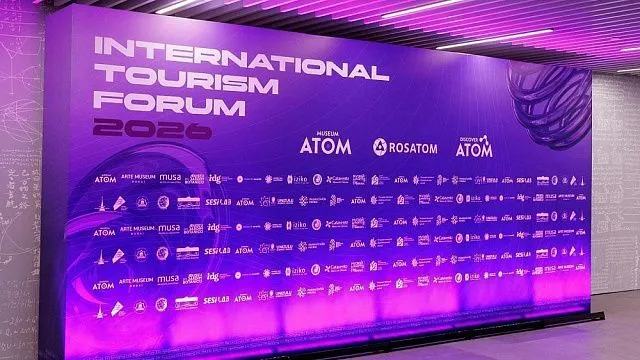

From 15 to 17 October 2026, the 3rd International Tourism Forum “Discover ATOM” took place in Moscow. The event was hosted at the ATOM Museum at VDNKh. The forum brought together representatives of science and technology museums, as well as experts in the fields of education and tourism from 17 countries. A live broadcast of the event was available in 56 countries worldwide. The TV BRICS International Media Network acted as the forum’s international media partner.
In a video address to the forum participants, Maria Zakharova, an official spokesperson for the Russian Ministry of Foreign Affairs, noted that such international events contribute to the development of dialogue between countries and the strengthening of ties between their peoples.
The theme of this year’s forum was “Science as the Language of the People of the Future”. Participants discussed how science museums can encourage young people to study the natural sciences, develop science tourism and strengthen international ties through the exchange of knowledge and cultural dialogue.
“The museums of the future should go beyond preserving and presenting knowledge. They should become places that inspire scientific curiosity, encourage new perspectives, and connect people around the world through shared experiences,” said Youngkwang Kim, Deputy General Manager of the Arte Museum in Dubai.
According to the expert, science museums play an important role not only in showcasing scientific achievements and knowledge but also in creating opportunities for the exchange of ideas and perspectives between people from different countries and cultures.
“The task of a modern science museum is to make this dialogue accessible to a wide audience and, through science, to strengthen mutual understanding between people and countries,” emphasised Elena Mironenko, Director-General of the ATOM Museum and Head of the BRICS Alliance of Science and Technology Museums.
According to Youngkwang Kim, an expert from Dubai, the museums of the future face four key challenges: preserving scientific and cultural heritage; presenting it in new ways using modern technology; creating memorable experiences for visitors; and bringing people together.
“To make this collaboration sustainable, it is essential to establish long-term partnerships and regular exchanges between researchers, museum professionals, and technology experts,” he believes.
One of the forum’s key events was the expansion of the BRICS Alliance of Science and Technology Museums. Twelve new members from Russia, Egypt, Thailand, Uzbekistan, Indonesia, Brazil, and Burkina Faso have joined the alliance.
“Initially, six countries joined this alliance; now the number of countries and museums is growing. There are more and more young people around the world who are interested in technical knowledge and in keeping pace with the rapid growth of technology,” said Aleksey Likhachev, Director General of the Rosatom State Corporation. He noted that over the past three years, more than 4.5 million people have visited the ATOM Museum at VDNKh.
Elena Mironenko reported that the roadmap of the BRICS Alliance of Science and Technology Museums for 2027–2030 provides for the development of joint exhibitions, educational programmes and tourist itineraries.
According to her, popular science tourism helps people to learn about the culture and history of other countries through their scientific achievements and contemporary research. Of particular importance is the popularisation of modern science, which will be in demand among children and teenagers in 10–20 years’ time.
“Science-based tourism is becoming a genuine tool for humanitarian cooperation – through knowledge, we learn about the culture, history and future of another country,” explained the head of the BRICS Alliance of Science and Technology Museums.
The forum paid particular attention to modern approaches to engaging with visitors.
“It is important to provide access to knowledge in a playful, interactive way and to spark an interest in the natural sciences and applied solutions as early as possible. The ATOM Museum has become not only a treasure trove of nuclear knowledge and history but also one of the centres of our international activities,” said Aleksey Likhachev.
Museums can go beyond the scope of traditional exhibitions and engage audiences through festivals, lectures by scientists, educational programmes, and events at the intersection of animation, film, music and modern technologies, noted Elena Mironenko.
“We are looking for new formats that allow people not just to receive ready-made information but to be amazed, to ask questions and to feel part of a shared scientific future,” she added.
On the final day of the forum, museum directors, curators and development specialists took part in workshops and exchanged expert insights on museum studies and tourism.