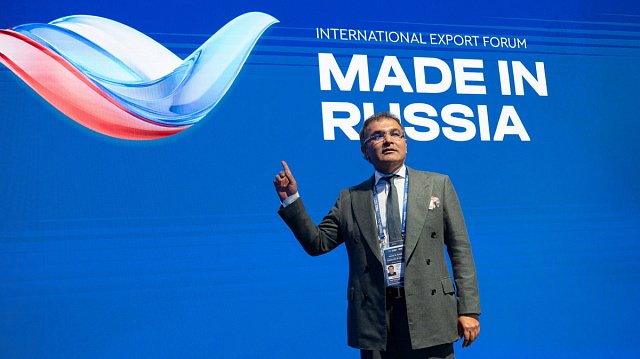

Russian manufacturers showcased innovations in the fields of industry, space, medicine and electronics at the “Made in Russia” International Export Forum. In exclusive comments to the TV BRICS International Media Network – which acted as the forum’s international media partner – representatives from Ghana, India, the United Arab Emirates (UAE), Indonesia, and Senegal spoke about the needs of their markets, their interest in Russian technologies and the conditions for developing joint projects.
Russian innovations for overseas markets
One such innovation is a specialised machine that uses a laser to perform high-precision machining of metal parts, creating complex three-dimensional structures on their surfaces. It can be used, in particular, for the manufacture and machining of die components. According to Ilya Groshev, head of the technology development and transfer department, Russian equipment enables complex manufacturing tasks to be carried out, whilst foreign solutions of comparable quality cost around five times as much. The machines have already been supplied to 17 countries, including the UAE, Kazakhstan, and Kyrgyzstan.
Another area of focus is ground-based satellite systems for receiving data from spacecraft and controlling them. The data obtained is used for mapping, monitoring ice conditions, observing fires and assessing the condition of agricultural land.

Photo source: Aleksey Mikhailov / TV BRICS
Chief Engineer Andrey Pivovarov explained that Russian antennas with a diameter of 4.5 metres are comparable in efficiency to foreign counterparts with a diameter of 7.3 metres. Outside Russia, the equipment has been installed in Belarus. Among the foreign customers is a Chinese organisation, which uses the Russian antenna to receive satellite signals.
Another development is a liquid-crystal module, the mass production of which has been organised in Russia for the first time. Previously, this component was sourced from abroad. It is used in the manufacture of displays, computers and interactive equipment. In the future, the technology may find applications in the automotive industry and public transport.
According to Dmitry Petrov, the company’s first deputy general director, interactive panels using Russian components have been installed in more than 120,000 school classrooms. The export prospects for the liquid crystal module itself have yet to be assessed, as its mass production is only just beginning.

Photo source: Aleksey Mikhailov / TV BRICS
In the medical sector, a device was presented for checking the quality of blood samples directly at the collection point. The device makes it possible to determine whether the sample is suitable for laboratory analysis or whether the patient needs to have their blood taken again. This helps to reduce the number of repeat tests and cut costs for healthcare organisations.
The device’s developer, Ekaterina Poliker, is considering entering the UAE market. However, international promotion requires further preparation: patent protection for the technology abroad has not yet been secured.
A system of ground stations for receiving satellite signals was also showcased at the exhibition. According to Vladimir Ivanov, director of the international sales department, there are currently around 80 such stations in operation in Russia and abroad. They enable the reception of telemetry and images from orbit with a resolution of up to 20 centimetres. In 2026, one of the stations was installed in India, with the next one planned for Madagascar.
Which Russian technologies are in demand abroad
In India, opportunities for Russian manufacturers extend beyond traditional product categories to include industrial equipment, medicine and pharmaceuticals.
Akashdeep Singh, President of the Indian Business Council – Russia, highlighted the lack of awareness amongst foreign consumers regarding Russian innovations. In his view, more active promotion of products and manufacturers’ participation in international industry events could help to expand trade.
“Russia has enormous potential, but many opportunities remain untapped. We have seen equipment for the food industry and interesting solutions in the field of unmanned technologies. […] Russian manufacturers should look beyond their traditional export markets. Above all, foreign consumers need to know what is produced in Russia and what problems these technologies can solve,” said Singh.

Photo source: Aleksey Mikhailov / TV BRICS
Farooq Mir, Vice-President of the association, who works in the pharmaceutical industry, believes that expanding the supply of medical products to India holds great promise. He highlighted the scale of the local market and the opportunities for Russian manufacturers.
“I travel all over Russia and see that there are many interesting technologies here. I am confident that Russian innovations can be more economically attractive than similar solutions from Western countries. […] Pharmaceutical and medical products are not yet being supplied to India in the volumes that are possible. Now is the right time for Russian manufacturers to secure their place in the Indian market,” said Mir.
In Ghana, there is interest in robotics and unmanned systems. Lawrence Awuku-Boateng, President of the Ghana-Russia Business Development Council, highlighted opportunities for educational cooperation: robotics is already being developed in local schools, and educational institutions are taking part in international competitions.
“One of our country’s secondary schools has already won an international robotics competition. I would like to explore opportunities for cooperation with Russian educational institutions and organise exchange programmes. […] We are also interested in drones, which can be used in various sectors, including transport,” said Boateng.
Mohamad Kamil Al Muaini, founder and chairman of the International Institute for Cultural Diplomacy in Dubai, believes that the UAE could serve as a platform for introducing Russian technologies to an international audience. He highlighted the UAE’s multi-ethnic population and the potential of sector-specific trade fairs.
“People from over 200 nationalities live in the UAE. When Russian companies showcase their innovations at exhibitions here, an international audience can learn about them. Medical and digital technologies are of particular interest. […] Some of my acquaintances have travelled to Russia for medical treatment, and their experience was successful. It is important to raise awareness in the Arab world of the capabilities of Russian specialists,” noted Al Muaini.

Photo source: Aleksey Mikhailov / TV BRICS
Among other promising areas, he cited clean energy and sustainable agriculture. These technologies are particularly relevant for the UAE due to its limited water resources.
In Indonesia, demand for Russian solutions is linked to the development of the energy sector, agriculture, medicine and education. Lubarto Sartoyo, President of the Alliance of Business Structures and Entrepreneurs of Southeast Asian Countries, identified five key areas of cooperation that meet the country’s needs.
“Indonesia’s economy is growing by more than 5 per cent a year, so it is essential to ensure it has sufficient energy capacity. There are opportunities for cooperation with Russia in both nuclear and green energy. […] We need food supplies and agricultural technologies that will enable us to develop our own production. Healthcare, pharmaceuticals, education and the creative economy – including film, fashion, design, architecture, and information technology – are also important,” said Sartoyo.

Photo source: Aleksey Mikhailov / TV BRICS
Serin, an entrepreneur from Senegal living in Moscow, drew attention to the lack of industrial and medical infrastructure in African countries. According to him, this problem limits the opportunities for professionals who are educated abroad but, upon returning home, are not always able to apply the knowledge they have gained.
“In Africa, there are educated professionals, including doctors, who have studied in Europe and Russia. But upon returning home, they often lack the equipment and infrastructure to put their knowledge into practice. […] We need partners who are prepared to develop the local economy, rather than simply coming here for resources. There are investment opportunities in the energy sector, road construction and other industries,” said Serin.
What is needed to enter foreign markets
Participants identified direct contacts between entrepreneurs as one of the prerequisites for the development of international trade. In India, it is suggested that there should be more active engagement with regional chambers of commerce and industry, as business opportunities are not limited to the largest cities.
“India is not just Delhi and Mumbai, just as Russia is not just Moscow and St Petersburg. Both countries have many regions with well-developed manufacturing sectors. […] We need to organise more frequent meetings between entrepreneurs, manufacturers and consumers so that they can familiarise themselves with products and identify opportunities for cooperation,” emphasised Farooq Mir, Vice-President of the Indian Business Council – Russia.
To operate in Ghana, Russian manufacturers need to take the country’s climatic conditions into account. Lawrence Awuku-Boateng, President of the Ghana-Russia Business Development Council, believes it is important to move away from supplying finished products towards localising certain production processes.

Photo source: Aleksey Mikhailov / TV BRICS
“It is much warmer in Ghana than in Russia, so the equipment must be adapted to the local climate. […] It is important for us not simply to receive finished goods. We want our partners to organise assembly and production locally and create jobs,” noted the President of the Ghana-Russia Business Development Council.
Sika George Kwame, an official spokesperson for the Volta Regional Coordinating Council (Ghana), also spoke about the country’s export opportunities at a press conference with journalists. Among the food products that Ghana is ready to supply to Russia, he mentioned coconuts, mangoes and coconut powder.
Lubarto Sartoyo highlighted changes in the preparation of Russian entrepreneurs for doing business in South-East Asia. According to him, in the past they did not always have sufficient knowledge of the region’s specific characteristics, including the business mindset and communication styles. Educational programmes run by the Russian Export Centre are now gradually helping to address this issue.
“Previously, there was insufficient understanding of how to operate in these markets and what to look out for. This is not just about logistics and payments but also about the specific characteristics of the business mindset and communication styles. The situation is now gradually changing thanks to the training programmes run by the Russian Export Centre, which is doing a great deal of work in this area,” said Sartoyo.
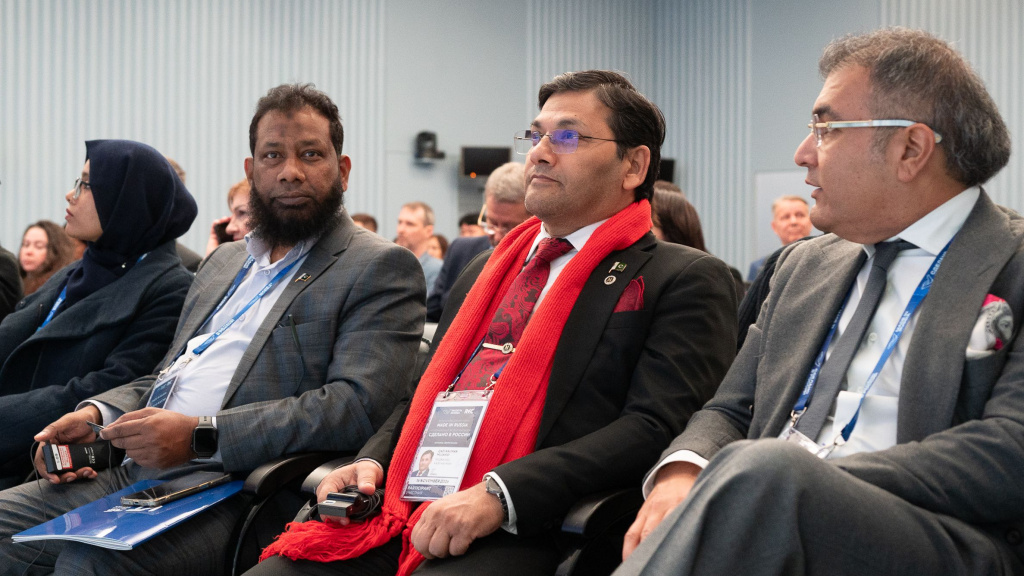
Photo source: Aleksey Mikhailov / TV BRICS
Entrepreneur Serin also emphasised the importance of reliable local contacts. According to him, there are investment opportunities in Africa across various sectors; however, to implement projects, it is necessary to find partners familiar with local conditions. Among the challenges, he mentioned international payments and the limited ability to use certain national currencies outside their home markets.
The “Made in Russia” International Export Forum took place at the National Center “Russia” in Moscow. The main theme of this year’s event was high-tech exports. Over 5,000 people from 89 countries took part in the forum. The programme included plenary discussions, country-specific business dialogues, pitch sessions and business negotiations between Russian and foreign companies. The organiser was the Russian Export Centre (REC).